
Sikhism – Theology, Sacred Texts, and Spiritual Path
Published on: 26-May-2026Sikhism (or more exactly the religion of the True Name - Sat Nam), is of Indian origin and markedly an Indian character. It rose four centuries ago as a quest for God. Sikhs are known as the people of military prowess; due to their warlike spirit, some even compare them with the Cossack and the Turk. Their military exploits brought them fame in India and have given them a name throughout the world. Nevertheless, the religion in itself is interesting. Sikhs have their peculiar priesthood, holy book, lofty theology, code of rigorous morality, sacred ritual, and the holy city with its noble sanctuary. The community numbers in the aggregate over five million.
Many tribes and castes make up the Sikh community. Many Sikhs are Jats - a solid, sturdy, resolute folk, the best agriculturists in northern India. It is pro-verbal that “The Jat’s baby is born with a plow-handle for a plaything.” They may be complacently disdainful, as a proverb shows: “The Jat stood on his dunghill as the Raja’s elephants went by; said he to the mahout, ‘Prithee, whose mice may these be?” The women and children work side by side with the men in the open fields. They are a self-reliant stock, reserved in demeanour, slow to speak, nevertheless often quick to strike. The religion has also had a distinguished political career, which became community.
Origins
Some Sikhs are drawn from the Arora tribe of merchants or small dealers. While others are from the Ramgarhia tribe, whose men are principally mechanics. Some are Khatris - Warriors, from whose stock sprang Nanak, the founder of Sikhism. There are Rajputs among them, although the Rajputs are the proud warrior race of Hinduism i.e. the ones who are the direct descendants of the Aryans and are pure-blooded. The Sikh Jat is rated lower than the Hindu Rajput, for Jats have practised widow-marriage. While Jats may rank as warriors in their estimation, high caste Hindus consider them as Shudras.
Character
A Sikh is a “learner” or “disciple” or possibly, “one who serves.” Anyone may yet, join this faith by accepting the doctrine and baptism. Whatever the extraction, Sikhs are usually affected by an ordinary consciousness that was first developed out of differences between Hindu and Muslim neighbours. They were later magnified by wars with the Muslims and the British. They are proud of their career and their inheritance. They are in theory a democratic nation, but dignified in bearing. What they have lacked in initiative and dash. They have made up in hardihood, courage, resolution and loyalty. To the temperament of the Jat Arora, Ramgarhia, and Khatri – often fighting men by nature – Sikhism has added the stimulus of a militant religion. Sikhs are the finest soldiery in all India, steady in victory, in defeat willing to die before yielding. Unquestioning loyalty to the leader dominates the soldier; and the heart does not quail before overwhelming odds, because he deems death on the field of conflict and instant access to the bliss of heaven. 1
History
Nanak, the founding father of the Sikh sect, is variously known as Guru Nanak, Baba Nanak, and Nanak Shah. The word Guru meaning 'spiritual preceptor,' Baba signifying 'father' or 'one worthy of reverence,' and Shah denoting 'king' or 'chief'. The first, moreover, being in origin Sanskrit and the last two Hindi and Persian respectively, while all three are commonly used to designate ascetics. Guru Nanak as we will prefer to call him, was the first of the ten Gurus of the Sikh community. Wherever representations of him are found, he is invariably shown as an old man with flowing white beard.
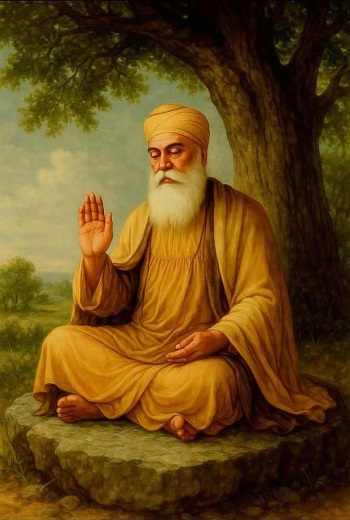
Nanak’s life
Baba Nanak was born in the month of Vaisakh (April-May), A.D. 1469, in the village of Talwandi. Now, owing to his fame, it is known as Nankana, about 30 miles south-west of Lahore. It is said that he was born on a moonlight night when a watch of the night remained. Celestial, 'unbeaten' music was heard, which doubtless means that auspicious omens in sounds and sights greeted the arrival of the infant. He was named Nanak Nirakari or Nirankari, i.e. 'Nanak, servant of the formless one.'
His father's name was Kalu. He was Khatri by caste and Vedi by clan. He was a small farmer, who also had the duties of land-steward for the owner of the village, Rae Bular, a Muslim Rajput of the Bhatti tribe of Rajputs. It seems that Kalu was a small merchant as well as a farmer and land steward. Nanak's early days were, therefore, spent in the freedom of farm and village life, and near the vast desert, which must have had endless charms and possibilities for him. As a boy, he seems to have exhibited remarkable talents. There was a manifest difference between him and the other lads. Because, while they were intent on the games that boys usually delight in, he was immersed in meditation on spiritual matters. He was of a dreamy disposition, so that, to his discredit, it is recorded that he lost everything that he took out of the house. This caused his father great annoyance, which led him to upbraid the priest who had on the occasion of the bestowal of a name on the child declared that the fame of his son would be like a canopy over him. ' An elegant canopy!' said Kalu.
At five he was able to talk about the Vedas and other Hindu Sastras. His father took him to school and, the auspices being declared good by the priest, he gave the customary presents to the schoolmaster to admit Nanak to the school.
At the age of nine he learned Persian, and after a time he left school. Then he decided to accompany the sadhus and fakirs, Hindu and Muslims mendicant ascetics who frequented the desert. Being in their company appealed more to him herding cattle or doing whatever another kind of farm labor; indeed, he brought trouble for his father when he fell asleep while herding his father’s buffaloes near a wheat farm. Due to his negligence, the buffaloes entered the wheat field and destroyed the crops.
It became evident to his relatives that he would not settle down to any regular work in Talwandi. Therefore, the plan was conceived of sending him to Sultanpur, in the district of Jalandhar, where his sister, Nanaki, the wife of Jairam, lived. By this time, he was married and had two sons, Sri Chand and Lakhmi Das. Leaving his wife and children, he travelled to Sultanpur, where, by the recommendation of his brother-in-law, who was employed in the commissariat of Nawab Daulat Khan, he obtained employment in Government service as a storekeeper. His wife, Sulakhni, the daughter of a Khatri of the same profession, and residing in Batala, a town of the present District of Gurdaspur, had been most unwilling that he should leave her, as is told pathetically in the janamsakhi.
At Sultanpur, he devoted himself to his duties and did so well that his faithfulness was recognized everywhere. Of his earnings, he employed a part in supporting himself, and the rest he gave away in God's name. Mardana, a village musician of the Dum class, and other professional players, came to see him from Talwandi and stayed with him. After performing his day duty, Nanak would make verses and sing them while Mardana played the accompaniment. Early morning, he used to bath in the Bein River. After that, he began the labours of the day, and we can very well believe the truth of the statement that, when, in weighing out provisions, he came to the number 13, which in Punjabi is ‘tera’. He would pause and mutter, 'Tera', which has the meaning also of 'Thine,' i.e. 'I am thine.' This is quite in accord with the Hindu mind and the ascetic manner.
He seems to have had a peculiar experience in Sultanpur. One day, while bathing, he remained in the water longer than usual. Whether he had fallen into a state of semi-consciousness while he was carried down by the stream, or whether he had emerged and become absorbed in meditation, it is not known. However, it is believed that he saw a vision in which he was commanded to 'remain in the name, give alms, perform ablutions, worship, and remember' the Lord.
Inclination Towards Sufism
From this time, we find him accompanying fakirs, except for an interval between the two occasions when his enemies accused him of squandering the money of the Government. On both occasions, the balance of his accounts proved his thorough honesty, but this annoying experience of suffering at the instance of detractors determined him to have done with the world altogether. Henceforth, we know him only as the itinerant bard preacher accompanied by his musician Mardana, who plays the Rabab, or Rebekah, an instrument of the nature of the violin. 2
Journeys
Guru Nanak travelled extensively during his lifetime. Some contemporary accounts state that when he left his family for a thirty-year period, he visited Tibet, most of South Asia and Arabia at the age of 27 years in 1496. 3 These claims include Guru Nanak visiting the Mount Sumeru of Indian mythology, as well as Makkah, Baghdad, Achal Batala and Multan. He debated religious ideas with the competing groups in these places. It is one of the claims against Sikhism that these stories became widely popular in the 19th and 20th century, and exist in many versions. 4
The hagiographic 5 detail is a subject of dispute. Modern scholarship questions the details and authenticity of many claims. Such as Callewaert and Snell state that early Sikh texts do not contain these stories. These travelogues appeared first time in hagiographic accounts of Guru Nanak centuries after his death. They continued to become more sophisticated over time. With the late phase, Puratan version describes four missionary journeys (udasis), which, differs from the Miharban version. 6 Some of the stories about Guru Nanak's extensive travels appeared first time in the 19th-century versions of Janam-Sakhi in the Puratan version. Further, stories about Guru Nanak's travel to Baghdad do not exist even in the early 19th century Puratan version.
According to Callewaert and Snell, these embellishments and insertion of the new stories claim closely parallel of miracles by Islamic Saints found in Sufi Tazkiras of the same epoch. These legends may have been written in a competition. 7
Another source of dispute is the Baghdad stone inscription in a Turkish script, about which some interpret that Baba Nanak Fakir was there in 1511-1512. While other interpret it as 1521-1522 (and that he lived in the Middle East for 11 years away from his family). Also, some Western scholars, in particular, state that the stone inscription is from the 19th century and the stone is not a reliable evidence that Guru Nanak visited Baghdad in the early 16th century. 8 Further, beyond the stone, no evidence or mention of Guru Nanak's journey in the Middle East is found in any other Middle Eastern textual or epigraphical records. Claims are asserted of additional inscriptions, but no one could locate and verify them. The Baghdad inscription remains the basis of writing by Indian scholars that Guru Nanak journeyed in the Middle East, with some claiming, he visited Jerusalem, Makkah, Vatican, Azerbaijan, and Sudan. 9
Origin of doctrine
Now some account of the Sikh religion is presented. Many antecedent factors lent it impetus. The faith is not original. It has a nationalistic temper at the outset, for it arose when the Mughals were vigorously enslaving the Punjabis. It assumed tendencies which had long been felt in Hinduism and Islam. The Hinduism of the masses was Puranic, with a veritable riot of gods and goddesses. Likewise, there were Sunni, and Shi'i Muslims, but among them were Sufis and Muslim mystics too. Moreover, among the Hindus were many bhaktas, practitioners of Bhakti to Krishna, Rama, or some other deity as a means of salvation. The Bhakti movement was affecting Muslims as well. Nanak, the first Sikh, was in the line of succession with many bhaktas. There were Ramanuja, of the eleventh century, Ramananda and Namdev, of the fourteenth, and Kabir, whom Nanak may have known in person.
Ramanuja was primarily a Vedantist. However, he taught release through knowledge of the Lord Vishnu, by devotion (Bhakti) and meditation towards him. Ramananda, a Hindu Bhakta who taught in Banaras, worshipped Rama and Sita and taught salvation through Bhakti to Rama. Though he was a Brahman and reserved the priestly function to his caste, yet among his disciples were a Muslim, a Jat, a Shudra, a woman, and an outcast. Namdev, some of whose verses are included in the Granth, was a low-caste tailor and a poet of the heart who was widely influential in the Maratha and the Panjab country. Kabir gave evidence of the interaction of Hindu and Muslim thought, of the interplay of Vishnu-ism and Sufism in particular. In the Granth Sahib are seventy-four hymns and two hundred and forty-three slokas or verses of his composition.
From Kabir to Guru Nanak
Kabir (1440-1518) was a younger contemporary and (possibly) a disciple of Ramananda. It is still disputed that to what folds Kabir belonged by birth. His name is Islamic. It appears that his mother was a Brahman and his father was a Muslim weaver. Legend says that at his death, both Hindus and Muslims claimed his body. Hindus wanted to burn, while Muslims demanded to bury. Flowers were miraculously substituted, and the body snatched away; then Hindus burned half the flowers at Banaras, and the Muslims buried half at Maghar (where Kabir disciples are still responsible for his tomb).
Reared in a Muslim family of poor weavers in Banaras, he was subject to the influences of both Islam and Hinduism. On adopting the religious life, he gave instruc-tion to Hindus and Muslims alike. He gained admission once to a sect of Vishnuism, but he was much opposed to idols. He was affected by Sufi mysticism. He felt commis-sioned to a reconciliation of mystical Islam and non-idolatrous sects of Hinduism. In the end, he was spurned by both parties, and became a free-lance in religion, establishing the other sect known as Kabirpanthis, "followers of the way of Kabir.
Kabir wrote in blunt, but his ideas are susceptible of elegant translation. Rabindranath Tagore has beautifully rendered one hundred of his poems into English. The gospel of Kabir was universal. All men were brothers and alike before God. Kabir accepted karma and transmigration, which makes him Hindu and not Muslim, but he found release through the love of God. He was in rigid theist, denounced idols, questioned the validity of the Vedas, Puranas, and Quran, and urged men to hate apprehension of the Divine. He proclaimed that people might find God, the Real, in their homes, in their souls. He found God, both in nature and in man, yet distinct from both. He was a Bhakta, holding that religion without Bhakti was no religion, whatever its asceticism, pilgrimages, alms-giving, or intelligence. Said he, "Utter the name of God: he extinguishes birth and death." “I utter his name, and whatever I see reminds me of him; whatever I do become his worship."
Baba Guru Nanak (1470-1540), was a disciple of Kabir. He may have met him in Banaras at the age of twenty-six when Kabir was an old man. 10
Theology and rituals
The distinctive tenet of Sikhism is monotheism. Though the existence of the countless gods and goddesses of the Hindu pantheon is not denied, yet their worship is not inculcated and may be said to be implicitly condemned. The Granth repeatedly condemns idolatry. Nevertheless, the masses worship the Granth itself in almost the same way as Hindus worship images. It is, however, difficult in India to draw the line between worship and reverence. Sikh theology is somewhat nebulous. Guru Nanak's idea of God is pantheistic rather than theistic, but he displayed an utter disregard of form and formal theology. He respected every religion so far as its real essence was concerned, but despised mechanical worship in any aspect. Guru Govind Singh made Sikhism more formal. He forbade smoking and cutting of the hair at any period of life. As a uniform, he prescribed the wearing of the five k's, viz. the kes (long hair), the kachh (short drawers ending above the knee), the Kara (iron bangle), the kirpan (sword), and the kangha (comb).
The Sikh retains the Hindu reverence for the cow, but is a meat-eater and disregards most of the Hindu ceremonial in the preparation of food. A kind regard for animal suffering, however, makes him eschew all flesh, not killed by a single stroke of the sword or jerk of the neck. The gurus sternly prohibited female infanticide. Sikh women are permitted to acquire education, especially in the semi-sacred Gurmukhi script. At weddings the Hindu ritual is discarded, no Brahman need be employed, and Vedic texts are dispensed with. The worship of Ganesh and the planets is not allowed, and in recent years an agitation for an independent marriage ritual led to the passing of the Anand Marriage Act (Act 1 of 1909). In this rite, the Adi Granth is circumambulated instead of fire, and texts from it are recited to sanctify the union as emblematical of that between the soul and the Supreme. Metempsychosis is a cardinal tenet in Sikhism, and each successive guru was Nanak; indeed, Guru Hargobind so signed himself. Where Sikhism has failed as a social force is in the abolition of the caste system. Nanak did not attempt its condemnation. He observed its rules and was content to preach that God cared not for a man's caste but his deeds. Guru Govind Singh abolished it in theory, but in practice, Sikhism fully recognises caste distinctions, though at initiation, and in theory, after it, all Singhs may be equal. 11
The teachings of Nanak
Nanak, like Kabir and others, sought to synthesise the best elements of Islam and Hinduism. He took from each religion what he thought of most importance. From Islam, he took the teaching that there is but one God. While Hindus may see this God at work in many ways and various disguises, still God is one. Sikhs refer to this God as "The True Name."
- There is but one God, whose name is true, the Creator, devoid of fear and enmity, immortal, unborn, self-existent; by the favour of the Guru.
- The True One was in the beginning; the True One was in the primal age.
- The True One is now also, O Nanak; the True One also shall be. 12
Nanak also taught that "The True Name" is the creator of the entire universe and that human beings are God's supreme creation. Thus, Nanak rejected the teaching of Ahimsa, which is so important to many Indian religions. Since people are the first creation, they are free to kill and eat animals. Sikhs are among the few Indians who may legitimately eat meat.
Nanak adopted several other elements of Hinduism. He accepted the principle of reincarnation, which is fundamental to many Indian religions. Sikhs came to believe that the spirit of Nanak was reincarnated in the bodies of those gurus who succeeded him as the leaders of Sikhism.
Nanak also taught the Indian principle of karma and believed that people continue to acquire karma and live again and again until they are freed from this cycle by "The True Name."
Nanak rejected the ceremonials and rituals of both Hinduism and Islam. He taught a very plain and straightforward form of religion which distrusted and rejected ritual.
The Muslims praise the Sharia, read it, and reflect on it; However, God's servants are those who employ themselves in His service to behold Him. The Hindus praise the Praised One whose appearance and form are incomparable; they bathe in holy streams, perform idol-worship and adoration, and use copious incense of the sandal. The Jogis meditate on God the Creator, whom they call the Unseen, Whose form is a minute, whose name is the Bright One, and who is the image of their bodies. 13
According to one story, Nanak was ejected from Muslim worship once because he laughed aloud during the sermon of the Imam. When he was asked why he was so disrespectful to Muslim worship, he replied that he had perceived that the imam was not thinking about God while he was preaching, but was, in fact, thinking about his horse and worrying lest the horse falls into a well. This perception struck Nanak as being so ludicrous that he burst into laughter.
Another element in the religion of Nanak was his pacifism. This man, in all his travels and with all the rejection that he received, maintained the stance of a pacifist. He never struck out at his enemies, and apparently, he taught his disciples to follow this pattern. In contrast to the teachings of Nanak, Sikhs, in their later history, became known as the most militant of warriors.
Holy Book
Granth Sahib is considered the sacred text in Sikhism. Granth is simply the Sanskrit word for ' book,' and Sahib is an Arabic word for 'Lord,' and this title of the two combined is indicative of personality and greatness, wisdom and power; the Sikhs look on this book as their Lord, whom they must obey. It is a collection in Panjabi, Hindi, and even Persian, of moral poems and apophthegms composed and uttered by Guru Nanak and other religious and philosophical teachers.
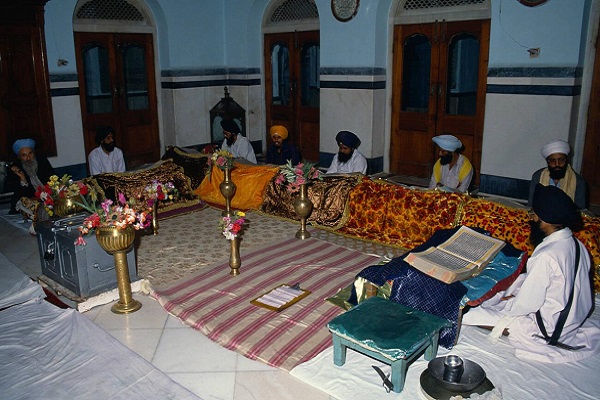
This collection was compiled in A.D. 1604. From its contents can be deduced a fair conception of the development of religious ideas from the 12th to the 16th cent, for the various compositions in the book are those of Bhagats ('saints') scattered over that period, including, of course, Guru Nanak. It shows to what extent Nanak indebted to his predecessors in the Indian field of was thought within those limits of time, and how much their influence tended to bring about the remarkable reformation that took place. 14
Succession
Nanak appointed Bhai Lehna as the successor Guru, renaming him as Guru Angad, meaning "one’s very own" or "part of you." Shortly after proclaiming Bhai Lehna as his successor, Guru Nanak died on 22nd September 1539 in Kartarpur, at the age of seventy.
Ten Gurus, Garnath and Usher
The death of Baba Guru Nanak thus started a series of Gurus (spiritual guide) in Sikhism. Sikhs indeed accept their ten gurus as their religious leaders; these ten gurus after the death of Guru Nanak taught and explained the laws of the religion for two and a half century. This chain lasts till ten gurus then the Holy book “Garnath” was ranked and accepted as a guru. This book is at present known as “Shiri Adi Garnath” or “Gayane Guru Garnath”.
The Gurus 15
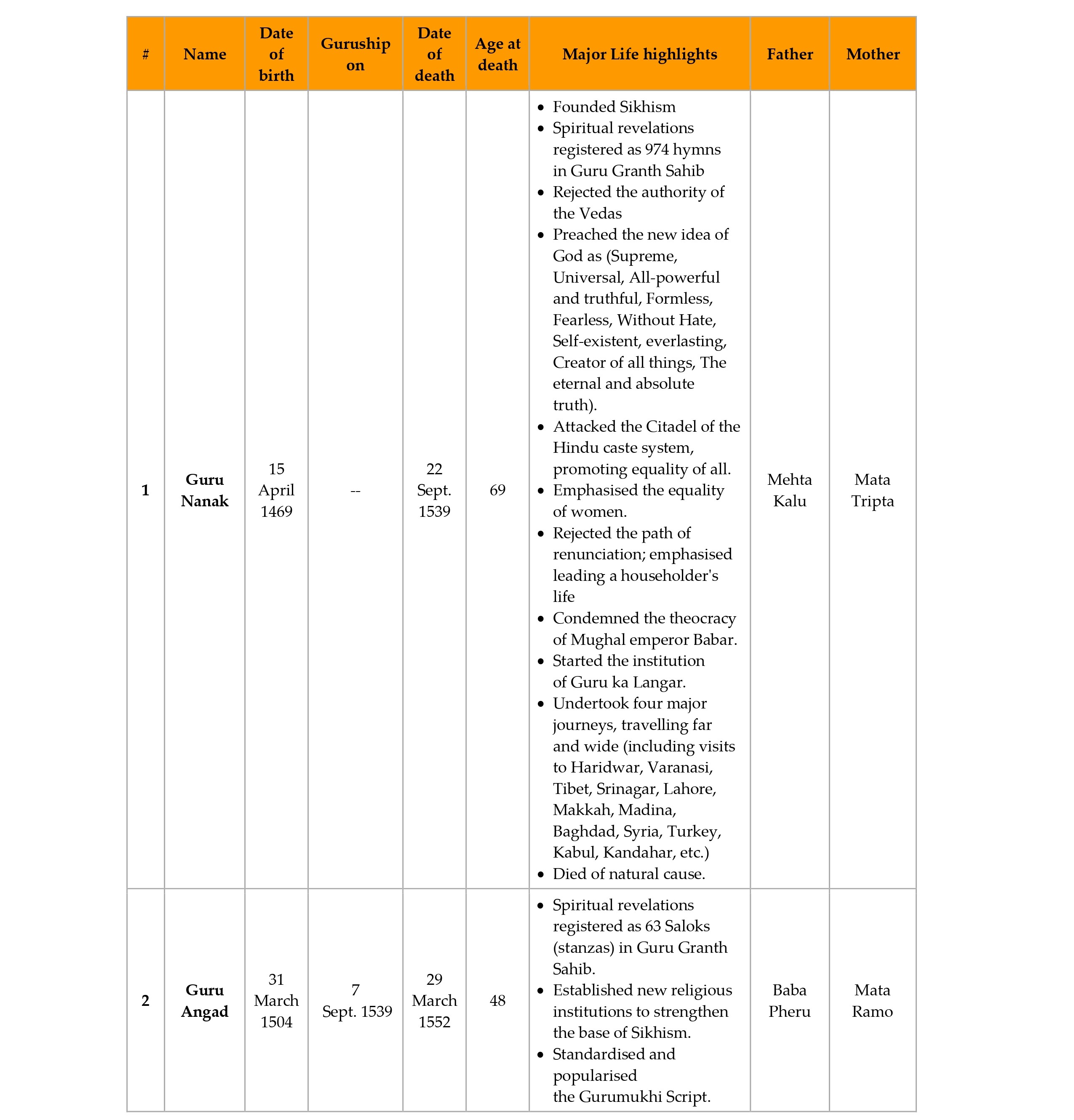
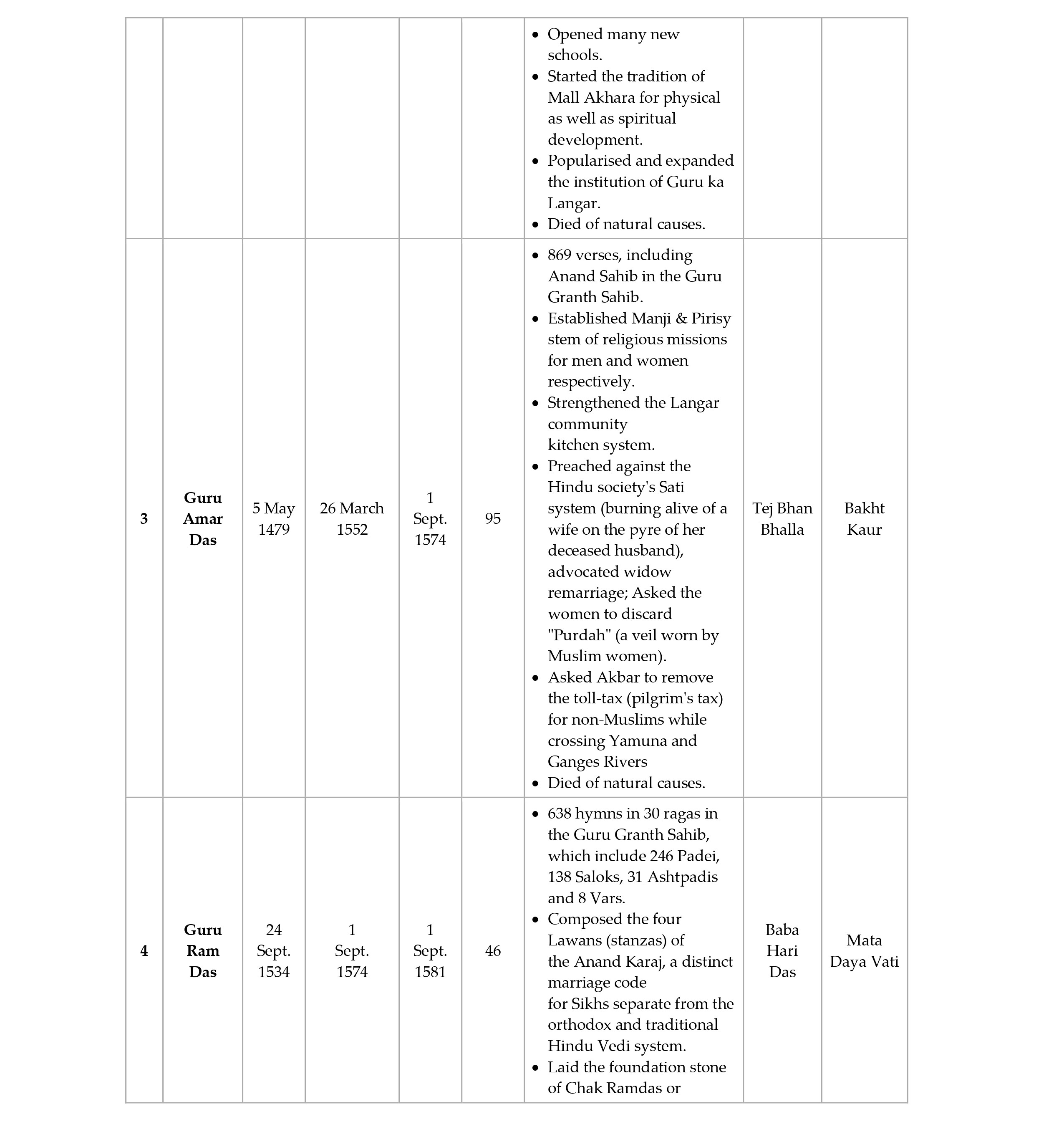
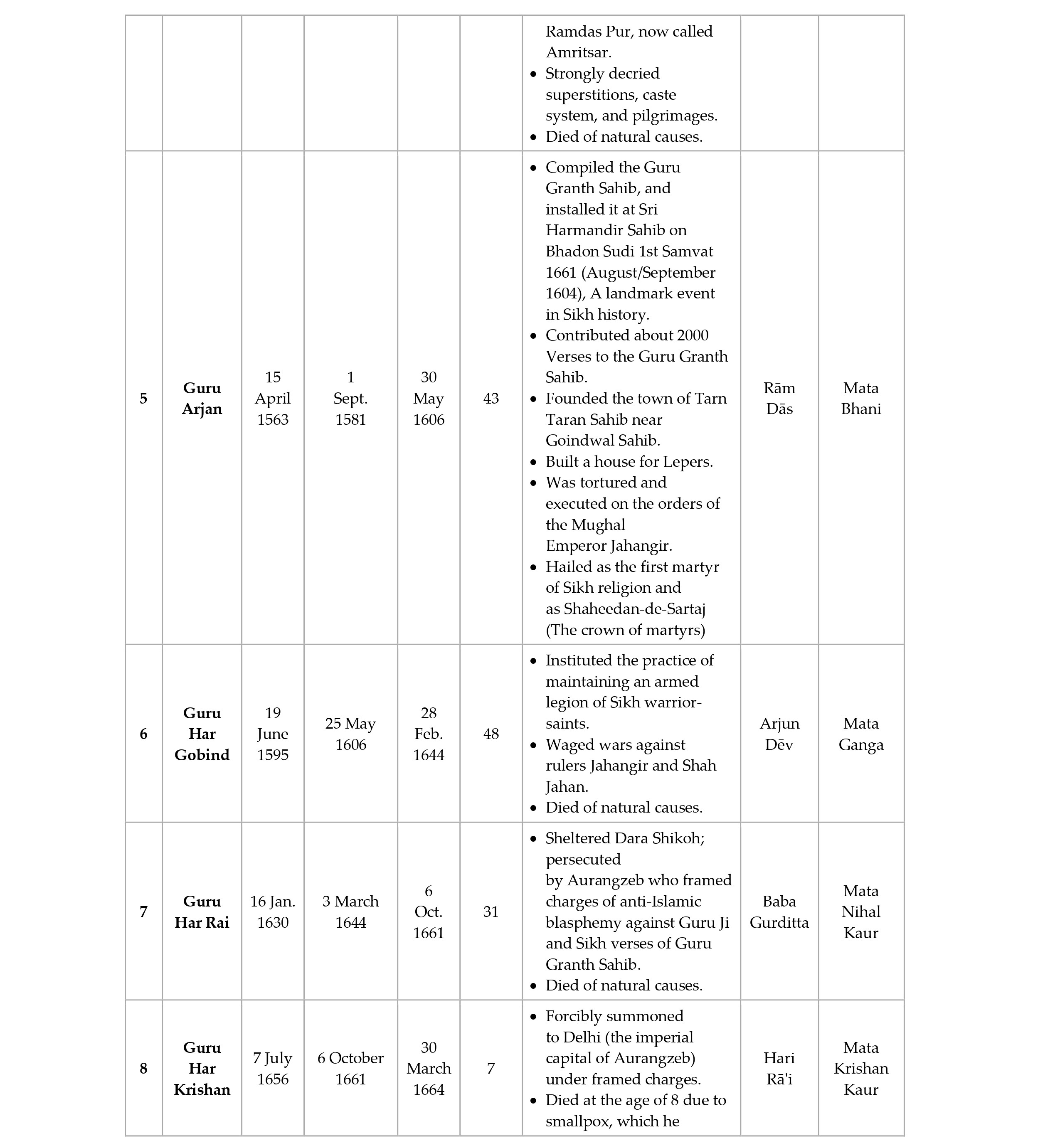
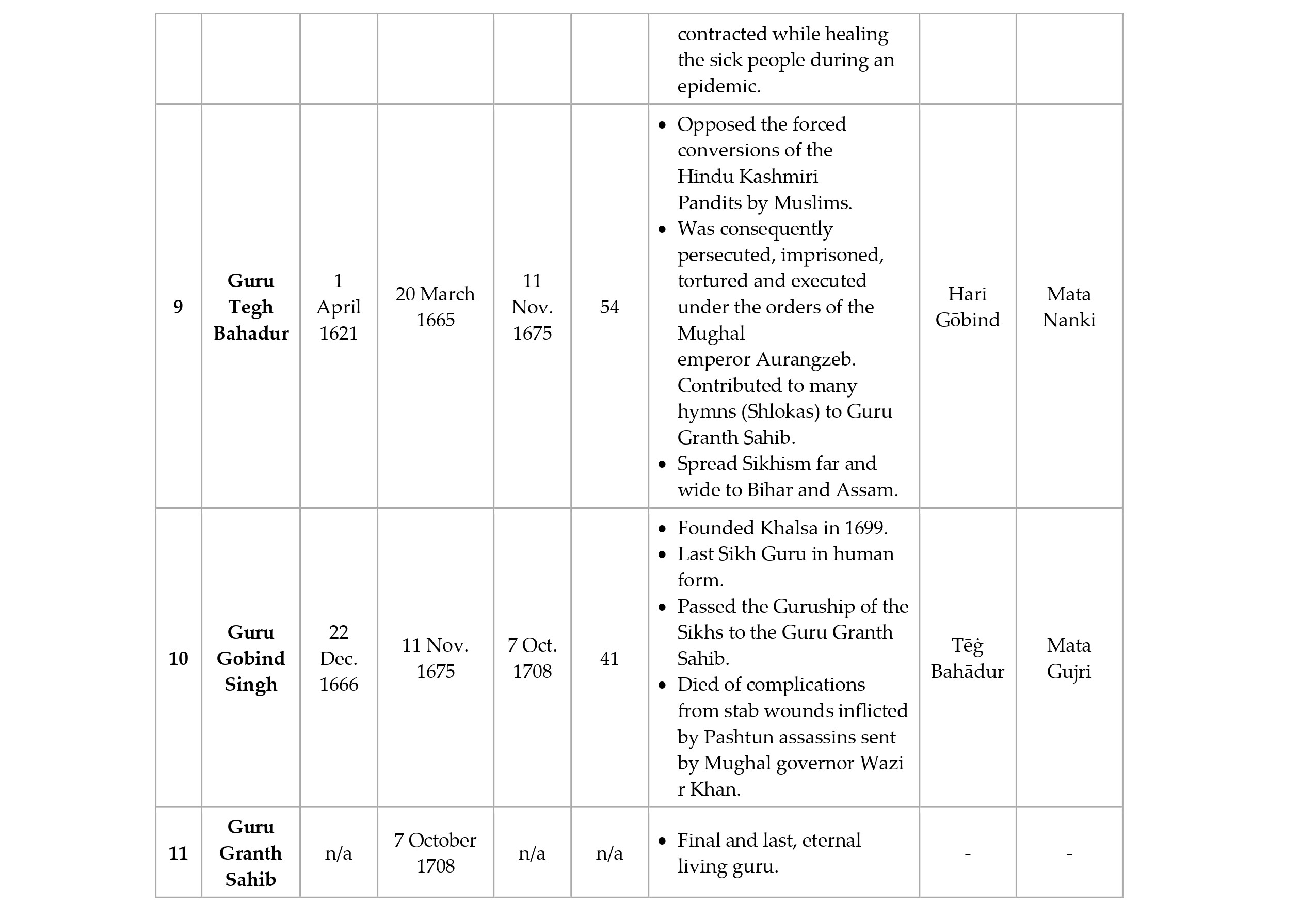
After Guru Nanak, we find the biography of the next four gurus in the book “Janam Sakhi” which apparently shows that all gurus have high and deep relations with the Muslim Sufis. Also, their way of living was also close and influenced by the Islamic way of life. Although they had their dealings with the rulers of the time, yet they kept themselves apart from politics. Sikhism was completely revived after the fifth “Guru Arjun” (1563-1606). The politics also influenced it. Guru Arjun compiled a holy book of Sikhs and constructed a great temple called “Hari Mandir” at Amritsar. Besides, he began taking “Usher” (Arabic: عشر, 10% of total saving) from his community and appointed Usher collectors in every area. Usher collecting also helped in the development of Sikhs in the society.
- 1 John Clark Archer (1958), Faiths Men Live By, The Ronald Press Company, New York, USA, Pg. 329-330.
- 2 James Hasting (Editor) (1912), Nanak, Encyclopedia of Religion and Ethics, T.&. T. Clark, New York, USA, Vol. 9. Pg. 181-183.
- 3 Jagbir Johal (2011), Sikhism Today, Bloomsbury Academic, London, U.K, Pg. 125.
- 4 Winand M. Callewaert; Rupert Snell (1994), According to Tradition, Hagiographical Writing in India, Otto Harrassowitz Verlag, Wiesbaden, Germany, Pg. 26–27.
- 5 The writing of the lives of the saints.
- 6 David N. Lorenzen (1995), Bhakti Religion in North India: Community Identity and Political Action, State University of New York Press, New York, USA, Pg. 41–42.
- 7 Winand M. Callewaert, Rupert Snell (1994), According to Tradition, Hagiographical Writing in India, Otto Harrassowitz Verlag, Wiesbaden, Germany, Pg. 26–27.
- 8 V. L. Ménage (1979), The "Guru Nanak" Inscription at Baghdad, The Journal of the Royal Asiatic Society of Great Britain and Ireland, Cambridge University Press, Cambridge, U.K, No. 1, Pg. 16-21.
- 9 Mahinder N. Gulati (2008), Comparative Religious and Philosophies: Anthropomorphism and Divinity. Atlantic Publishers, New Delhi, India, Pg. 316–319.
- 10 John Clark Archer (1958), Faiths Men Live By, The Ronald Press Company, New York, USA, Pg. 332-334.
- 11 James Hasting (Editor) (1912), Sikhs, Encyclopedia of Religion and Ethics, T.&. T. Clark, New York, USA, Pg. Vol. 11, 510-511.
- 12 The Japji, Preamble, quoted from Lewis M. Hopfe (1979), Religions of the World, Glencoe Publishing Co. Inc, Ohio, USA, Pg. 152.
- 13 Asa ki War, Slok VI, quoted from Lewis M. Hopfe (1979), Religions of the World, Glencoe, Publishing Co. Inc, Ohio, USA, Pg. 153.
- 14 James Hasting (1912), Nanak, Encyclopedia of Religion and Ethics, T.&. T. Clark, New York, USA, Vol. 9, Pg. 182.
- 15 https://en.wikipedia.org/wiki/Sikh_gurus: Retrieved: 08-12-2016
Hamdani, Mufti Shah Rafi Uddin & Khan, Dr. (Mufti) Imran. (2018), Sikhism – Theology, Sacred Texts, and Spiritual Path, Encyclopedia of Muhammad ﷺ, Seerat Research Center, Karachi, Pakistan, Vol. 1, Pg. 811-824.
https://muhammadencyclopedia.com/article/en/sikhism-theology-sacred-texts-and-spiritual-path