
Buddhism – Doctrines, Sacred Texts, and Important Traditions
Published on: 21-May-2026A glimpse of the world history shows that in the sixth century before Christ, many religious campaigns were raised. They emerged against the complications of the practicing religion of that time and transgressions in its name. These movements gave complete attention to the correction of the individuals’ mindset about the religion. Buddhism also began with the same intention by Gautama Buddha, who also known as Siddhartha Gautama, Shakyamuni Buddha, or simply the Buddha. It is the religion of a mystical kind whose beginning is registered in the fifth century before Christ in Nepal, and today Buddhism is among one of the most prominent religions of the present world.
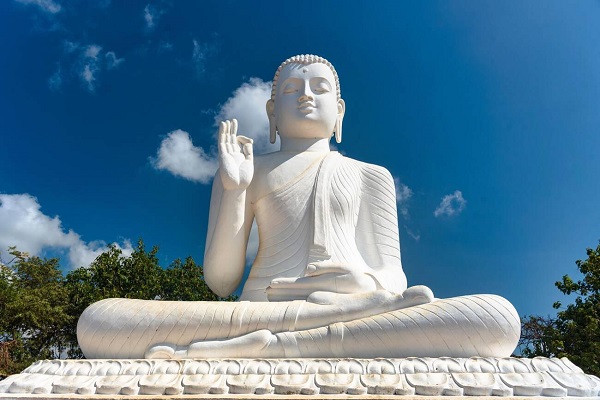
Emergence of Buddha
The epoch of the fourth century before Christ was of much importance. The religious traditions of Arya and Hindustan were mixed with each other up to this era. Religious customs were getting complicated, and the dominion of a particular class (Brahmans) was planted over them who held themselves superior and dominant among all people. The Sanskrit language was also developed in the same era. Changes were made in the religion. The four castes came into existence which has been discussed in the chapter of Hinduism. The successful nations of Hindustan gave the religious prestige to this caste system. A pattern was set that castes could marry neither each other nor they were permitted to sit together. In these situations, a huge mass of general public becomes tired of the caste system in the religion. They were in search of the way which could resolve problems of their spiritual and worldly life. In such situations, Buddha emerged and proved himself to be the saviour of Hindustani people and disseminate the awareness of respect for humanity.
Gotham Buddha
Buddha was born in the Lumbini Park at Kapilav atthu on the Indian borders of present Nepal on the full moon day of May, 623 B.C. His father was King Suddhodana of the aristocratic Sakya 1 clan, and his mother was Queen Maha Maya. His mother died seven days after his birth. Maha Pajapati Gotami, the younger sister of his mother, married to the King and adopted him, entrusting her son, Nanda, to the care of the nurses.
Naming ceremony
Buddha was named Siddhartha, which means “wish fulfilled” on the fifth day after the birth. His family name was Gotham. By the ancient Indian custom, many learned Brahmins were invited to the palace for the naming ceremony. There were eight distinguished men amongst them. Examining the characteristic marks of the child, seven of them raised two fingers each, indicative of two alternative possibilities, and said that he would either become a Universal Monarch or a Buddha. However, the youngest, Kondanna, who excelled others in wisdom, noticing the hair on the forehead turned to the right, raised only one finger and convincingly declared that the prince would retire from the world and become a Buddha. 2
Married life
Buddha married his beautiful cousin Yasodhara at the early age of sixteen. She was also sixteen years old. After his happy marriage, he led a luxurious life, blissfully ignorant of the vicissitudes of life outside the palace gates for nearly thirteen years. About his luxurious life, he says:
“I was delicately brought up, O monks; highly delicate, exceedingly delicate was my upbringing. At my father’s house lotus ponds were made: in one of them, blue lotuses bloomed, in another white lotus, and in a third red lotus, just for my enjoyment. I used only sandal unguent from Benares, and my headdress, my jacket, my undergarment, and my tunic was made of Benares muslin. By daylight and by night a white canopy was held over me, lest cold and heat, debris, chaff or dew should trouble me. I took in three palaces: one for the summertime, one for the winter and one for the rainy time of year. In the palace for the rainy time of year, during the four months of the rains, I was waited upon by female musicians only, and I did not get down from the palace during these months. While in other people’s homes, servants and slaves receive a meal of broken rice together with sour gruel, in my father’s house they were given rice and choice meat.” 3
With the march of time, truth gradually dawned upon him. His contemplative nature and boundless compassion did not allow him to pass his time in the mere use of the fleeting pleasures of the Royal Palace. He experienced no personal grief, but he felt a deep compassion for suffering humanity. Amidst comfort and prosperity, he realised the universality of grief.
Renunciation
One glorious day as he went out of the palace to the pleasure park to see the world outside, he came in direct contact with the stark realities of life. Within the narrow confines of the palace, he saw only the rosy side of life, but the dark side, the common lot of humanity, was purposely veiled from him. What was mentally conceived, he, for the first time, vividly realised in reality. On his way to the park, his observant eyes met the strange sights of a decrepit old man, a diseased person, a corpse and a dignified hermit. The first three sights convincingly proved to him, the cruel nature of life, and the universal ailment of humanity. The fourth signified the means to overcome the ills of life and to attain calm and serenity. These four unexpected sights served to increase the urge in him to loathe and renounce the world.
Realising the worthlessness of sensual pleasures, so highly prized by the world and appreciating the value of renunciation in which the wise seek delight, he decided to leave the world in search of Truth and Eternal Peace.
When this final decision was taken after much deliberation, the news of the birth of a son was conveyed to him while he was about to leave the park. Contrary to expectations, he was not overjoyed, but regarded his first and only offspring as an impediment. An ordinary father would have welcomed the joyful tidings, but Prince Siddhartha, the extraordinary father as he was, exclaimed – “An impediment (Rahu) has been born; a fetter has arisen”. His grandfather accordingly named the infant son Rahula.
He ordered his favourite charioteer Channa to saddle the horse Kanthaka and went to the suite of apartments occupied by the princess. Opening the door of the bedroom, he stood in the doorway and cast his dispassionate glance on the wife and child who were fast asleep.
Great was his compassion for the two dear ones at this parting moment. Greater was his compassion for suffering humanity. He was not concerned about the future worldly happiness and ease of the mother and child as they had everything in abundance and were well protected. It was not that he loved them the less, but he loved humanity more.
Leaving all behind, he stole away with a light heart from the palace at midnight and rode into the dark, attended only by his loyal charioteer. Alone and penniless, he set out in search of truth and peace. It was in his twenty-ninth year that Prince Siddhartha made this historic journey.
He journeyed far and, crossing the river Anoma, rested on its banks. Here he shaved his hair and beard and handing over his garments and ornaments to Channa with instructions to return to the palace, assumed the simple yellow garb of an ascetic and led a life of voluntary poverty. The ascetic Siddhartha, who formerly was in the lap of luxury, now turned a penniless wanderer, living on what little the charitably-minded gave of their accord.
He had no permanent abode. A shady tree or a lonely cave sheltered him by day or night. Barefooted and bareheaded, he walked in the scorching sun and the piercing cold. With no possessions to call his own, but a bowl to pick up his food and robes just sufficient to hide the body, he reduced all his energies in the pursuit of truth.
Search
Gotham was not gratified with a discipline and a doctrine which only led to a high degree of mental concentration, but did not result in “disgust, detachment, cessation (of suffering), tranquillity; intuition, enlightenment, and Nibbana.”
Before long the intelligent ascetic Gotham mastered his doctrine and attained the final stage of mental concentration, the Realm of Neither Perception nor Non-Perception revealed by his second teacher, Uddaka Ramaputta whose gathering he joined after Alara Kalama.
The noble teacher was delighted to hear of the success of his illustrious royal pupil. Unlike his former teacher, the present one honored him by inviting him to take full charge of all the disciples as their master. On the contrary, Gotham still felt that his quest for the highest truth was not achieved. He had gained complete mastery of his mind, but his ultimate goal was far ahead. He was seeking for the highest, the Nibbana, the full cessation of suffering, the total eradication of all forms of craving. Dissatisfied with this doctrine too, he departed thence, content therewith no longer.
He realized that his spiritual aspirations were far more eminent than those under whom he chose to learn. He realized that there was no-one capable enough to teach him what he yearned for – the highest truth. He also realized that the highest truth is to be found within oneself and ceased to seek external aid. 4
To suppress his spiritual thirst, Gotham reached a forest while he was wandering. At that place, he found five hermits who joined him in meditation. He did such hard practices and rigors that his beautiful body was reduced to a skeletal system of bones and his eyes shrunk back in to his skull. Gotham continued these strict practices for about ten years, but he did not win in taking anything from these exercises. Thus he passed on these tough practices that nothing could be gained through starvation and hunger. By watching his condition, Gotham found out that leaving moderationand giving pain to the body was a useless act and eternal peace could not be gained from it. He came to see after this practical experiment that by physical pain and starvation, nothing is attained except pain. Therefore, he decided to look after his soul, but his companions were not impressed by this decision of Gotham because they believed that without bearing the physical pains, obtaining the salvation was impossible.
Mahatma Gotham got the indication through a dream that giving pain to the body and leaving the worldly activities completely was wrong. The true path was moderation and equality. He called back a moment in childhood when he had seen his father plough the field at the start of the season. He attained a concentrated and focused state which was blissful and refreshing, the Jhana 5. After stopping the practice, Gotham decided to perform meditation once again the same evening. That time he was determined that no matter what happened, whether the body expired, or the bones cracked, he would not leave it till he accomplished the highest bliss. His decision was not contradictory to the previous observation because this time he was not putting the burden on himself more than his physical capabilities. Still, he desired to perform meditation by staying in comfort. With this passion, he made there a cushion of grass under the Pipal Tree now known as the Bodhi tree—in Bodh Gaya, India, where he vowed never to arise till he found the truth. Kaundinya 6 and four other companions, believing that he had abandoned his search and become undisciplined, left him. After a reputed 49 days of meditation, at the age of 35, he is said to have attained enlightenment 7, and became known as the Buddha or "Awakened One" ("Buddha" is also sometimes translated as "The Enlightened One").
According to some sutras of the Pali Canon, at the time of his awakening, he realized comprehensive insight into the Four Noble Truths, thereby attaining liberation from Samsara, the endless cycle of rebirth, suffering and dying again 8. According to scholars, this story of the awakening and the stress on "liberating insight" is a later development in e Buddhist tradition, where the Buddha may have regarded the practice of Dhyana as leading to Moksha910 and Nirvana 11.
In Buddha religion, this word is articulated to the person who has attained knowledge of God means achieving the highest bliss and who is calling the others towards the light by getting salvation from the worldly sorrows and darkness. At that time, his age was 39, and that is why he was called Buddha which means ‘Aarif’ in Urdu language.
Formation of the Sangha
After his awakening, the Buddha met Taphussa and Bhallika — two merchant brothers from the city of Balkh (currently Afghanistan) who became his first disciples. It is said that each person was given hairs from his head, which are now claimed to be enshrined as relics in the Shwe Dagon Temple in Rangoon, Burma. The Buddha intended to visit Asita, and his former teachers, Alara Kalama and Udaka Ramaputta, to explain his findings, but they had already died.
He then travelled to the Deer Park near Varanasi (Benares) in northern India, where he set in motion what Buddhists call the Wheel of Dharma. He delivered his first sermon to the five companions with whom he had sought enlightenment. Together with him, they formed the first Saṅgha: the company of Buddhist monks.
However, the organisation of the Sangha in the Buddha’s lifetime was not in the form as it appeared later. The Triratna (three jewels) was apparently conceived as a unit, for the Buddha said in terms that after his passing the Sangha was founded as a missionary enterprise within a few weeks of the Enlightenment.
The function of the Buddhist Sangha is twofold, to provide the best possible conditions for individual development, and to teach the Dhamma to humanity. The Buddha's Sangha, however, was dynamically conceived. His first converts were his first missionaries, and he convinced his followers to dedicate their lives for the service of all living things. The Sangha, indeed, was the necessary means whereby he could make known his teaching. Where books were unknown, the Bhikkhus became his walking library, and by them alone, when he had passed away, could the message be accurately and widely spread. While the Buddha lived, he was head of the order. When he died, there were none to succeed him. Each monastery (Vihara) within each school, elected its head, who continued the Buddhist teachings according to his beliefs. 12
The frist sermon of Buddha
This sermon holds a lot of importance in the buddhist religion. The introductory key words are as follows:
“Bhikkhus (monks), these two extremes ought not to be practiced by one who has gone forth from the household life. What are the two? There is devotion to the indulgence of sense-pleasures, which is low, common, the way of ordinary people, unworthy and unprofitable; and there is devotion to self-mortification, which is painful, unworthy and unprofitable.”
“Avoiding both these extremes, the Tathagata (referring to the Buddha himself) has realized the middle path: It gives vision, it gives knowledge, and it leads to calm, to insight, to enlightenment, to Nirvana.”
“And what is that middle path? It is simply the noble eightfold path, namely, right view, right thought, right speech, right action, right livelihood, right effort, right mindfulness, right concentration. This is the middle path realized by the Tathagata, which gives vision, which gives knowledge, and which leads to calm, to insight, to enlightenment, to Nirvana.”13
After this, Gotham Buddha continued to preach, and many famous personalities like kings , queens, princes and princesses accepted his religion. At this point, Gotham Buddha advised his monks to go to the distant areas and spread the teachings of this Dharma. The followers of Gotham Buddha abided by the message strictly and dispersed into different parts of the world. Out of them, one group was observing the teachings of Gotham and worldliness in balance. Hence, they spread the Buddhism according to it. While the other group was among those dervish, who had broken the relations with the world. Therefore, they did the duty more emphatically and enthusiastically than the first group.
During the term of Buddhism, people in the second group were called monks, and collectively they are called Singh. Gotham Buddha continued to take both the groups with success in his life. He actively preached his religion for twenty-one years, therefore many people accepted it and started following his teachings. His death occurred at Koshi Nagar (presently Kashi of District Gor Khapoor) at the age of Eighty (80) years approximately.
Background of Gautama’s mission
Buddhism is essentially a rebellion against the falsehoods, evils and tyrannies of the Hinduism of the 5th century B.C. Hindu writers seem keen to look out for this detail. It is entirely possible that Hinduism, in one or more of its many strains, emerged in history as an authentic religious belief founded on revealed truth. It must surely have been monotheistic. Over time, that truth was corrupted with polytheism and idolatry. The subversion of truth led, in turn, to the destruction of values. The human being is a moral existence, and the primary aim of religion is to build the character and good personality of the individual, and through the individual, humanity at large. Hinduism had completely lost sight of this objective and had replaced character building with idol-worship and ritualism as ends-in-themselves.
Secondly, Hinduism had robbed the individual of his freedom and individuality (except where he was a Brahman) and had chained him in the rigid fetters of the caste-system. It is the institution which forms the cornerstone of the Hindu social order.
Buddha arose to set the perspectives right. It was because of this background that he confined his teachings to ethics and refused to discuss metaphysics (with which India was already oversaturated). Only then could we possibly understand and explain his silence about the problem of the existence or non-existence of God. It may be, also, that because India was (and still is) steeped in idol worship and the worship of thousands of gods and goddesses, the reversion from such rank polytheism, naked anthropomorphism and animistic idolatry to a monotheism might have been too sudden a step. Perhaps it was necessary that the slate be first wiped clean. Hence, the Buddha remained silent on the question of God. (He did not deny the existence of God!). Likewise, he stayed silent in respect of a transcendental dimension of existence (i.e., the unseen world) for, on being queried as to what would be the lifespan of the Buddhist who attained Nirvana (salvation), he replied with the analogy of a fire. He asked: what becomes of a flame after it is extinguished?
The revolt against Hinduism is enshrined in the movement of the religious consciousness from a stagnant and slavish ‘dependence’ in Hinduism, to a free and dynamic ‘self-dependence’ in Buddhism. In fact, Buddha’s parting words to his disciples before he died were: All fundamental things are subject to decay. Work out your salvation with diligence! This revolt in found in Buddha’s scathing denunciation of ritualism and sacrifice. Likewise, he declared the Vedas and Vedic teachings to be rather useless! The second point to note is that Buddha, like Muhammadﷺ and Jesus علیہلسلم set the individual free. Anyone could attain salvation. Salvation is not restricted to the priestly caste of Brahmans who monopolised the reading of the sacred writings and who poured molten lead into the ears of every Sudra who dared overhear their interpretation! Buddha gave the Brahmans a slap in the face, which found a resounding echo in the harsh and bitter condemnation of the Jewish Rabbis, Scribes and the Pharisees by Jesus علیہلسلم and Muhammad ﷺ . Buddha, in fact, did away with the inhuman caste system and opened the doors of religion to the lowest of the low.
The positive influence of Hinduism on Buddha was such that in its essential characteristics, it was and is virtually an offshoot of Hinduism. The uniquely Hindu doctrines of Karma and Awa Gawan (reincarnation and transmigration of souls) which form the foundation of the Hindu philosophy of religion, were accepted by the Buddha and absorbed into Buddhism (though in a modified form). 14
Some basic doctrines of Buddha
Being a philosopher as well as a spiritual pioneer, Buddha discarded all claims of special revelation and all appeals to authority or tradition. He found his standard of truth, and his way of discriminating it from error, in the common reason and experience of men as they can be brought to bear on the universal problem of life.
What is that problem? According to him, existence is painful. The conditions that make an individual sad are precisely those that also give rise to dissatisfaction and suffering. Individuality implies limitation; limitation gives rise to desire; and, inevitably, desire causes suffering, since what is desired is transitory. 15 Nevertheless, Buddha was confident that by the clarifying application of reason for the lessons of experience, one could discriminate the conditions of genuine health of the personality from their meretricious counterparts. Moreover, one can likewise discriminate the qualities of mind the dependably further those conditions from qualities that fail to do so or are hostile to them.
Buddha was confident that a rational analysis of the core lessons taught by the experience could locate the root of evil. Because it lies in the inner nature of each human being – that root whose uprooting was necessary and sufficient if any person is to find true well being for himself and become a source of true well being for others. This analysis yields the specific Buddhist understanding of the universal problem of man, and the way of uprooting it.
The gist of the basic analysis is given in his famous sermon of Benares in which Buddha shared his insight with others. Perhaps the reader will comprehend better the significance of that discourse if it, in anticipation, is translated as the essence of his meaning into more familiar Western terms. It consists of the “Four Noble (Ayan) Truths,” which can state as follows:
- Existences are unhappiness.
- Selfish craving causes unhappiness.
- Selfish craving can be destroyed.
- It can be destroyed by the following the eightfold path whose steps are:
- Right understanding.
- Right purpose. (Aspiration)
- Right speech.
- Right conduct.
- Right vocation.
- Right effort.
- Right alertness.
- Right concentration.
What is it that? Firstly, since every creature is born under the conditions of finite existence, hence every living creature is subject to the evils of sickness, old age, and death and to the sadness that comes, when these ills strike his loved ones. These inevitable occasions of unhappiness constitute the basic problem of life. However, they would not make us unhappy. Were it not for the blind demandingness in our nature which leads us to ask of the universe, for ourselves and those especially dear to us, more than it is ready or even able to give. Moreover, it is this same unrealistic and selfish craving which frustrated as it inevitably becomes, moves a human to act in ways that increase the unhappiness of others. Hence, this is the factor which each person is responsible for bringing under control, so that he may be a source of genuine and dependable wellbeing to himself and others. Moreover, under the Bodhi tree, Buddha had discovered that such complete destruction is possible: others too, who have followed him have made the same discovery, and their achievement gives us further proof.
The way to such destruction lies in treading the eight steps resolutely on the right path. The person who has reached this stage is no longer subject to rebirth. He enters Nirvana, which is to be conceived not as sheer extinction, but as the state naturally produced by the destruction of tanha- a state marked on the positive side with a sense of liberation, inward peace and strength, insight into truth, the joy of complete oneness with reality, and love toward all creatures in the universe. 16
Holy Books
The books, which are the basis of Buddhism are called Tri Pitaka (three baskets). All these books are in the public language of before Christ “Pali”.
Pali Literature
The Pali texts, Tri-Pitaka is so important that it may be taken as the Bible of Buddhism. It is conceded to be among the earliest recorded Buddhist literature and is placed in the 1st Century B.C. It, therefore, depends on a long, prior, oral tradition. The Tri-Pitaka, or three baskets of law, is composed of three books:
- Vinaya Pitaka- ‘Rules of conduct.’ This is the book of discipline. The original Buddhism was par excellence, the Buddhism of the Bhikshus (monks) who lived the monastic life to be trained for preaching and disseminating the religious teachings of Gautama Buddha. This monastic life had to be strictly ordered. The Vinaya Pitaka deals, in the main, with the ‘rules of the order’.
- Sutta Pitaka- ‘Discourses’. The Sutta Pitaka is a collection of the sermons and discourses of Gautama Buddha and incidents in his life. It is, perhaps, the most important of the Pitakas as a sourcebook of Buddhist doctrine. It consists of five divisions known as Nikayas. Gautama Buddha was essentially an ethical thinker.
- Abhidhamma- ‘Analysis of Doctrine’. This third basket is the basket of metaphysical doctrines. It is known as the Buddhist metaphysics. However, in particular, it formed the foundation of the Realist schools of the Buddhist Philosophy (Sautrantika, or Critical Realism, and Vaibhashika, or Direct Realism).
Similarly, the most readable book in Buddhism is the Dhammapada. 17 It is the part of a second book. Nevertheless, it is entirely attributed to the quotes of Gotham Buddha. Therefore, it is read the most in the Buddhist community. This book was written in almost the third century before Christ. The Buddhist scholar and commentator Buddhaghosa explains that each saying recorded in the collection was made on a different occasion in response to a unique situation that had arisen in the life of the Buddha and his monastic community. His commentary, the Dhammapada Atthakatha, presents the details of these events. It is a rich source of legend for the life and times of the Buddha. This book has been translated into Urdu, Hindi, English, German, Chinese, Thai, Tamil Bengali, and many important languages.
Sanskrit Literature
While Pali was used or almost monopolised by the Hinayana sect of Buddhism, Sanskrit was preferred by their Mahayana rivals. We may also note that their attitudes to their scriptures show a marked contrast. The Hinayana scriptures (Tri-Pitaka, for example) simply present an account, both historical and analytical, of the Buddha and Buddhist teachings and precepts. The Mahayana school, on the other hand, shows a distinct tendency to ascribe sacred propensities to the texts.
The Sanskrit texts (of Mahayana) it appears, have not been reduced to a collection or a Canon (as in Pali). Much of the original Sanskrit literature has been lost. Fortunately, some of them were translated into other languages (mostly Chinese). They are preserved in Chinese and are now being retranslated back into their original Sanskrit.
The most famous work in Sanskrit, the Mahavastu, has been restored from its Chinese translation. The Mahavastu (which means ‘sublime story’) consists of a large collection of legendary stories.
Lalitavistara, another Sanskrit text, discovered by Prof. Hodgson, is regarded as one of the holiest of the Sanskrit texts. It belongs to the 1st century B.C., that is, some 500 years after the Buddha, and contains all the miracles which the superstition-loving folk had gathered on an obliging Buddha over this long stretch of time. 18
Teachings and beliefs
In conclusion, there is not much difference in the beliefs of Hinduism and Buddhism.
There is the concept of existence of God, many idols and reincarnation and Karma and all these have been discussed in Hinduism. We also find the statements regarding the Day of Judgment in the addresses of Ashok, but in “Pali” Scriptures, nothing is written about it. However, the underlying point of the teachings of this religion is not these beliefs, but comprised of spiritual and ethical discussions.
In the teachings of Gotham Buddha, there was a monastic way to worry. The sacrifice of the soul, forsaking the world with the teachings of meditation enlightens the hearts of the people. We see the concept of God, life after death and the holy books in Buddhism, but their value is found almost to be nonexistent. Buddhism was presented with the high ethical system at the time when the most of the religious beliefs were not present in the society. To fill this space many concepts of Hinduism and local religions of the idol, reincarnation, karma, and some others were added in Buddhism. To observe meditation, pondering and the ethical rules are of great importance in the religion of Gotham Buddha. Therefore, an overview of their teachings in the light of beliefs is presented here:
The concept of God
There is no particular concept of God in Buddhism. Commonly, the religious specialists call this religion a denier of God. In some places, we find such statements attributed to the Gotham Buddha in which they had given negative opinions about idols and God. However, it is clear from their context that it is a criticism of the concept of God in Hinduism. It's hard to believe about a religious leader that he kept complete silence about the concept of God in his whole life. Nevertheless, this is true that no clear statement about God is present in Pale Scriptures. In fact, it exists as an overview. Gotham Buddha has more or less a prestige of God in Mahayana sect. They declared the worship of Buddha along with different idols as compulsory, on the other hand, Therwaad sect declared the divine existence of God as false. They took Gotham Buddha as Acharya Monash means a man with extraordinary qualities.
The Buddha, like modern sociologists and psychologists, believed that religious ideas and especially the good idea have their origins in fear. The Buddha says: “Gripped by fear people go to the sacred mountains, sacred groves, sacred trees and shrines.”
According to them, primitive humans found themselves in a dangerous and hostile world. The fear of wild animals, of not being able to find enough food, of injury or disease, and of natural hazards like thunder, lightning and volcanoes were constantly with them. Finding no security, they created the idea of gods to give them comfort in good times, courage in times of danger and consolation when things went wrong.
Even today, you will notice that people tend to become more religious at times of crisis, you will hear them say that the belief in a God or gods gives them the strength they need to deal with life. You will hear them explain that they believe in a particular god because they prayed in time of need and their prayer was answered. All this seems to support the Buddha's teaching that the god-idea is a response to fear and frustration. The Buddha knew about the weaknesses of the people. He knew that normal humans fear, have worldly desires and resist change therefore he started to replace these concepts with rational beliefs which helped in improving the lives of the people.
The second reason the Buddha did not believe in the God is the claim that there does not seem to be any evidence to support this idea. It is said that there are numerous religions, all claiming that they alone have god's words preserved in their holy book, that they alone understand god's nature, that their god exists and that the gods of other religions do not. Some claim that god is masculine, some say that she is feminine and others that it is neuter. They are all satisfied that there is ample evidence to prove the existence of their god, but they laugh in disbelief at the evidence other religions use to prove the existence of another god. It is not surprising that even though many religions have spent centuries, trying to prove the existence of their gods, but have failed to provide any evidence to prove their claims. This is the reason why the Buddhists suspend this judgment till such evidence is provided.
The third reason the Buddha did not believe in the God is the assertion that belief is not necessary. Some claim that the belief in a god is necessary to explain the origin of the universe. However, this is not so. Science has very convincingly explained how the universe came into being without having to introduce the god-idea. Some claim that belief in god is necessary to have a happy, meaningful life. Again, we can see that this is not so. There are millions of atheists and freethinkers, not to mention many Buddhists, who live useful, happy and meaningful lives without belief in a god. Some claim that belief in god's power is necessary because of humans, being weak, do not have the strength to help themselves. Once again, the evidence indicates the opposite. One often hears of people who have overcome great disabilities and handicaps, enormous odds and difficulties through their inner resources, through their efforts and without belief in a god. Some claim that God is necessary to give man salvation. However, this argument only holds good if you accept the theological concept of salvation and Buddhists do not accept such a concept. Based on his experience, the Buddha saw that each human being had the capacity to purify the mind, develop infinite love and compassion and perfect understanding. He shifted attention from the heavens to the heart and encouraged to find solutions to our problems through self-understanding. 19
Ethical & philosophical teachings
Buddhism is different from the other religions in moral and philosophical teachings. According to this faith, the way of salvation for a person is only to follow the ethical manners and philosophical manners.
The Four Noble Truths
The Buddha's Four Noble Truths explore human suffering. They may be described (somewhat simplistically) as:
Dukkha
Dukkha explains that suffering exists: (Suffering is real and almost universal. It has many causes: loss, sickness, pain, failure, the impermanence of pleasure.)
Samudaya
Samudaya refers that there is a reason for suffering. (It is the desire to have and control things. It can take many forms: craving of sensual pleasures; the desire for fame; the desire to avoid unpleasant sensations, like fear, anger or jealousy.)
Nirodha
Nirodha says that there is an end to suffering. (Suffering ceases with the final liberation of Nirvana (a.k.a. Nibbana). The mind experiences complete freedom, liberation, and non-attachment. It lets go of any desire or craving.)
Magga
Magga expresses that to end suffering, one must follow the Eightfold Path. The detail of these eight aspects is following:
The Buddha's eightfold path
Panna: Discernment, wisdom:
- Samma Ditthi: Right Understanding of the Four Noble Truths It means Buddha’s view about the human life and salvation is the most appropriate one. The dogmas and customs of salvation mentioned in other religions are not seemed to be the right point of view.
- Samma Sankappa: Right thinking; following the right path in lifeIt means the thoughts about humanity that are free from hatred, anger, desire, torture, selflessness and possess human sympathy, love, and dedication. Regarding this, Metra (pity & love); Kiran (sympathy) and Ahmasa (no torture), are given exceptional importance in Buddhism.
Sila: Virtue, morality: - Samma Vaca: Right speech: no lying, criticism, condemning, gossip, harsh language
According to this rule, a person should prevent himself from the conversation based on a lie, spam, occultation, complaining, and obscenity. Instead of this, straightforward conversation, good morals, soft discussion and true stating be included right in the conversation. - Samma Kammanta: Right conduct by following the Five Precepts
According to this rule, the avoidance of these five things is important: lie, killing any living organism, sexual indecency, theft and the use of intoxicating stuff. - Samma Ajiva: Right livelihood; support yourself without harming others
It means to eat lawful (Halal) livelihood. Brutality, cheating, fraud, theft and earn by usurping someone’s right is the violation of this rule. According to Pale Scriptures, in this context Gotham Buddha himself prohibited five professions:
a. Professions related to buying and selling of weapons.
b. Professions related to taking the life of the animals and their meat and skin etc.
c. The business of intoxicating stuff.
d. Buying and selling of slaves.
e. Buying and selling of poison.
Here this should be clear that these five professions are prohibited for the whole Buddhist community without any discrimination. As far as Monks are concerned, any business or earning is forbidden for them. They can only meet their ends by begging.
Samadhi: concentration, meditation:
- Samma Vayama: Right Effort: promote good thoughts; conquer evil thoughts
It means to develop the favourite emotions and thoughts according to Buddhism and to struggle for throwing out the evil thoughts. This effort should be continued till the evil thought gets out of the person’s mind. - Samma Sati: Right Mindfulness: Become aware of your body, mind, and feelings
It means that by avoiding all sort of carelessness about the Nafs (soul), a person should always be focused on his thoughts, emotions, deeds and conversations. Do not perform any act without thinking and understanding. Every time keep the above-mentioned respective rules under consideration. - Samma Samadhi: Right Concentration: Meditate to achieve a higher state of consciousness
This is the most meaningful worship in Buddhism. There is no possibility to obtain highest bliss (salvation) in any condition without it. 20
The essence of Buddhism
Lewis Moore states it as:
“The Beginning of all sorrow…
Because of ignorance, there is individuality;
Because of Individuality, there is intellect;
Because of Intellect, there is separate name-and-form;
Because of name-and-form, there are the six senses;
Because of touch, there is sensation;
Because of sensation, there is craving;
Because of craving, there is grasping;
Because of grasping, there is individual existence;
Because of individual existence, there is earthly existence;
Because of earthly existence; there are decay and death
Thus, arises the chain of all grief and sorrow and despair
The end of all sorrow…
With the absolute cessation of ignorance, comes the end of individuality;
With the end of individuality, comes the end of the intellect;
With the end of the intellect, comes the end of separate name-and-form;
With the end of name-and-form, comes the end of the six senses;
With the end of the six senses comes the end of the contest;
With the end of the contract, comes the end of touch;
With the end of touch comes the end of craving;
With the end of craving comes the end of grasping;
With the end of grasping comes the end of individual existence;
With the end of the person existence, comes the end of earthly existence;
With the end of earthly existence comes the end of decay and death;
Thus, ends the chain of all grief and sorrow and despair. (Vinaya-Pitaka; Maha-Vagga)”
The Ten Buddhist Commandments.
- Do not destroy life.
- Do not take what is not given you.
- Do not commit adultery.
- Tell no lies and deceive no one.
- Do not become intoxicated.
- Eat temperately and not at all in the afternoon.
- Do not watch dancing, nor listen to singing or plays.
- Wear no garlands, perfumes or any adornments.
- Sleep not in luxurious bed.
- Accept no gold or silver.
(The first five commandments all Buddhists must observe all the time; the last five they must observe on fast days. The monk must observe all of them all the time.) (Vinaya-Pitaka; Maha-Vagga)
The Ten Perfections
- The first perfection is:
{Giving. As a full jar overthrown pours out the liquid and keeps back nothing, even so, shall your charity be without reserve – as a jar overturned. - { The second perfection is:
Duty. As a yak-cow, when the hairs of her tail become entangled in anything, would rather suffer death than injury to her tail, even so, should you keep your duty- as the yak to her tail. - The third perfection is:
Renunciation, as a man in prison, suffering pain for long, knows that there is no pleasure for him, but only to await release, so shall you look upon your existences on earth as prisons, and turn your face toward renunciation and await release. - The fourth perfection is:
Insight. As the beggar-monk shuns no families from whom he begs, whether lowly or high or in between, and acquires his daily fare, so shall you at all times question the wise and gain insight. - The fifth perfection is:
Courage. Like the lion, king of beasts, whether when lying down or standing up, lacks no courage, but is ever high-hearted, so also shall you in each of your individual-existences hold fast to your courage. - The sixth perfection is:
Patience. As the earth bears, all that is cast upon it, both the pure and the impure, and feels no resentment nor rejoicing, so also shall you receive favours and rebuffs alike with indifference. - The seventh perfection is:
Truth. As the star of healing is balanced in the heavens and swerves not from its path in its time and its season, so also shall you remain fixed on your path of truth. - The eighth perfection is:
Resolution. As the stone mountain, firmly based, quails not before the tempest, but abides in its place, so also shall you abide in your resolution once resolved. - The ninth perfection is:
Lovingkindness. As water quiches, the thirst of the good and the bad alike, and cleanses them of dust and impurity, so also shall you treat your friend and your foe alike with loving kindness. - The tenth perfection is:
Serenity. As indeed the earth looks with serenity on all the pure and impure that are impure that are cast upon it, even so, shall you approach with serenity both joy and sorrow – if you are to attain wisdom.
Thus, many are the things which in this world make wisdom, perfect; beyond these, there are no others. (Sutta-Pitaka; Buddha-Vasma) 21
Buddhist Satwa
This belief is a Mahayana community of Buddhism. According to this belief, the successors of the elapsed Buddhists are always concerned for the guidance of creatures. They have become eligible to achieve the highest bliss through their practice. However, to do sympathy to creatures and for their guidance, they promise that until all the creatures do not reach the highest bliss, they will not become a Buddha by achieving the highest bliss. These persons are known in Mahayana Buddhism through the name of Buddhist Satwa. It was considered that they have a sum-total of expenses in the world. In Mahayana’s, the worship is also used for these Buddhist Satwa. Their idols are created, and the devotion was also expressed to them because according to their beliefs, this Buddhist Satwa gives sacrifice for their salvation.
The earliest depiction of the Bodhisattva path in texts such as the Ugraparipṛccha Sutra describes it as an arduous, difficult monastic path suited only for the few which is nevertheless the most glorious path one can take.
Three kinds of Bodhisattvas are mentioned in the early Mahayana texts, the forest, city, and monastery Bodhisattvas - with forest dwellings being promoted as a superior, even necessary path in sutras such as the Samadhiraja Sutra and the Ugraparipṛccha Sutra. 22 The early Rastrapalapariprccha sutra also fosters a solitary life of meditation in the forests, far away from the distractions of the householder life. The Rastrapala is also highly critical of monks living in monasteries and cities who are seen as not practising meditation and morality. 23 The Ratnagunasamcayagatha also says the Bodhisattva should undertake ascetic practices (dihu tanga) 24, "wander freely without a home", practice the paramitas 25 and train under a guru to perfect his meditation practice and realization of Prajnaparamita. 26 These texts seem to indicate the initial Bodhisattva ideal was associated with strict forest asceticism.
Mahayana Buddhism encourages everyone to become bodhisattvas and to take the Bodhisattva vows. With these vows, one makes the promise to work for the complete enlightenment of all sentient beings by practicing the six perfections. 27 Indelibly entwined with the Bodhisattva vow is merit transference (pariṇamana).
In Mahayana Buddhism, life in this world is compared to people living in a house that is on fire. People take this world as reality, pursuing worldly projects and pleasures without realising that the house is on fire and will soon burn down (due to the inevitability of death). A Bodhisattva is the one who has a determination to free sentient beings from Samsara and its cycle of death, rebirth, and suffering. This type of mind is known as the mind of awakening (bodhicitta). Bodhisattvas take Bodhisattva vows (28) to progress on the spiritual path towards Buddhahood.
Karma
Karma is a Sanskrit term that means "action" or "doing." In the Buddhist tradition, karma refers to the measures driven by intention (cetana). 29 It is closely associated with the idea of rebirth.
According to Peter Harvey:
‘The law of karma is seen as a natural law inherent in the nature of things, like a law of physics. It is not operated by a God, and indeed the gods are themselves under its sway. Good and bad rebirths are not, therefore, seen as ‘rewards’ and ‘punishments’, but as simply the natural results of certain kinds of action. Karma is often likened to a seed, and the two words for a karmic result, vipaka and phala, respectively mean ‘ripening’ and ‘fruit’. An action is thus like a seed which will sooner or later, as part of a natural maturation process, result in certain fruits accruing to the doer of the action: just as one may get tasty edible fruits or inedible bitter ones, depending on what seeds one plant. The Christian expression ‘as one sows, so one will reap’ exactly fits this.’ 30
According to Gombrich, the Buddha defined karma as intentional; whether the intention manifested itself in physical, vocal or mental form. It was the intention alone, which had a moral character: good, bad or neutral The focus of interest shifted from physical action, involving people and objects in the real world, to a psychological process. 31
According to Gombrich, this was a great innovation, which overturns Brahmanical, caste-bound ethics. It is a rejection of caste-bound differences, giving the same possibility to reach liberation for all people, not just Brahmins:
Not by birth is one a Brahmin or an outcast, but by deeds (kamma). 32 How this emphasis on intention was to be interpreted became a matter of debate in and between the various Buddhist schools. 33
Concept of rebirth
The Buddhist perspective on rebirth states that it is not a pleasant affair. However, all unenlightened people are reborn, whether they like it or not, and whether they believe in rebirth or not. The process of life and rebirth has no inherent purpose; for it was not designed and created by anyone. Thus, for example, one is not reborn ‘so as to be able to learn spiritually’; rebirth may provide an opportunity for spiritual learning, but this is a fortunate side-effect of it. While one’s life is not seen as given a ‘purpose’ by a designing God, one can give one’s life a purpose, based on understanding the nature of life, its possibilities and problems. Accordingly, sensible aims are: to avoid causing suffering to oneself and others in this life; to gain relatively pleasant rebirths through good actions; ultimately to transcend rebirths altogether, and to help others to do so. Most Buddhists, therefore, aim for attaining a heavenly or a human rebirth, with the Arahat’s liberating experience of Nirvana as the long-term goal; the heavens are this side of salvation, with Nirvana as beyond the limitations of both earthly and heavenly existence.
Within the round of rebirths, all beings are part of the same cycle of lives. Each human being has been an animal, ghost, hell-being and god in the past, and is likely to be so again at some time in the future. Any form of suffering one witness in another human or other being has been undergone by oneself at some time. Thus, one should not cling to rebirths and should have compassion for other sentient beings. In one’s innumerable past lives, the law of averages dictates that most beings, one comes across. However, one might dislike them now, have at some time been a close relative or friend, so that loving kindness towards them is appropriate.
Such teachings, of course, urge a kindness and non-violence towards all forms of life. Humans are part of the same cycle of lives as other beings and are not separated from them by a huge gulf. Nevertheless, the more complex and developed a being is, the worse it is to harm or kill it; so, it is worse to kill a human than an animal.
Buddhist
According to this belief, Gotham Buddha was the first Buddha of Buddhism, but after him, several people have achieved the rank of Buddha by obtaining the highest bliss that’s why the followers of this religion not only follow Gotham Buddha but also follow the ways of other Buddhas as well.
The system of worship
In Buddhism, commonly those worships and religious customs are performed which are in Hinduism such as Pooja, praises of Devi and Devas, and so on. However, some sects are present, which are against it and do not believe on Devi and Devas. The worship which is given the most importance in Buddhism is meditation.
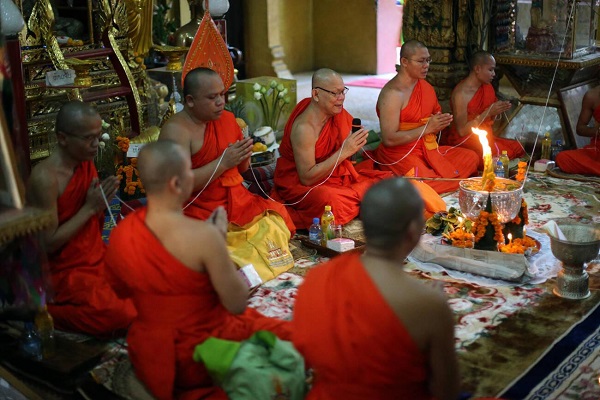
In meditation, people get to indulge in the deep state of pondering by getting transcend from the environment and the worldly life to obtain comfort and understanding. In common words, it means to keep the eyes closed, by keeping the mind clean from all worldly thoughts, then to focus thoughts on any one point. The discussion of many kinds of meditations is found in books about Buddhism. The custom of meditation is also found in Hindus and Muslims, but their states are different from each other.
The system of society
According to the sayings, Gotham Buddha had divided his followers into two groups in his life: one worldly and the second was the community of monastic. Gotham Buddha gave the knowledge of separate manners to both the communities.
Monastic or Monks
To take part in this group, it was necessary that the person should not be affected by any infectious disease. He should not be anyone’s slave or in indebtedness. He should have taken permission from his parents to spend his life devoted to this purpose. Other than the mentioned conditions, the person has to shave the head and has to adopt the life of isolation wearing the orange dress. After becoming a Monk, all the doors of earning money are closed, and nothing is left for that person except begging.
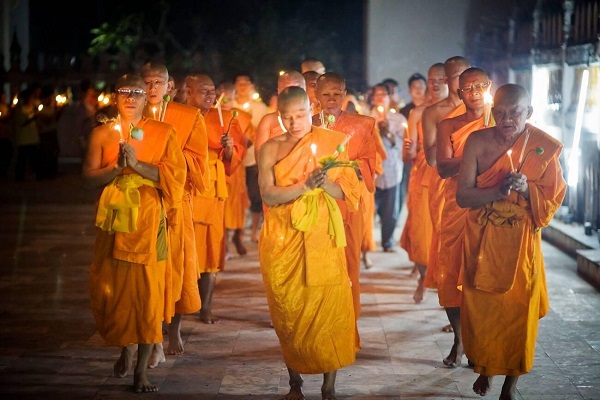
There are some rules and regulations for this begging; A monk cannot beg from anyone forcefully. He may stand outside the doors of the houses, if the people of the house drop something in his sack, he may take, else he has to move ahead. When the food is granted in a quantity which is enough for him to stay alive, then he gets back to his place. It is compulsory for a monk to wake up early in the morning for whole life to clean the monastery. Then for the achievement of purification of the heart, he should engage himself in prayers. There is no capacity for any luxury and comfort or easiness. His aim of life is only to gain knowledge, to spread it and to get the highest bliss.
Worldly person
In contrary to Monks, these people are allowed to be busy in the worldly works. It is important for them to keep the rules mentioned above in mind and to take out some part of their earnings for the Monks. Whenever these people want, they can become Monks by observing the mentioned guidelines.
The way of salvation
In Buddhism, the priority of the Buddha was to achieve higher rank (Nirvana) in his life. The difficulties or problems which were faced by the Buddha were released by gaining the state of salvation. According to the books on Buddhism, Nirvana is that state which is not understood by a common person in general.
According to the Buddhist teachings, after achieving the true path of life, an individual may achieve the power of salvation. When he receives this status of Nirvana, he finds the solution to all problems. As the Buddha says:
"This is peace, this is exquisite — the resolution of all fabrications, the relinquishment of all acquisitions, the ending of craving; dispassion; cessation; Nibbana". There's no fire like passion, no loss like anger, no pain like the aggregates, no ease other than peace. Hunger: the foremost illness. Fabrications: the first pain. For one knowing this truth as it is, Unbinding is the foremost ease. Freedom from illness: the foremost good fortune. Contentment: the foremost wealth. Trust: the foremost kinship. Unbinding: the foremost ease… and in terms of what it is not: "There is that dimension where there is neither earth, nor water, nor fire, nor the wind; neither dimension of the infinitude of space, nor dimension of the infinitude of consciousness, nor dimension of nothingness, nor dimension of neither perception nor non-perception; neither this world, nor the next world, nor sun, nor moon. Moreover, there, I say, there is neither coming, nor going, nor stasis; neither passing away nor arising: without stance, without foundation, without support (mental object). This, just this, is the end of stress.". . . "Birth is ended, the holy life fulfilled, the task done. There is nothing further in this world."34
Communities
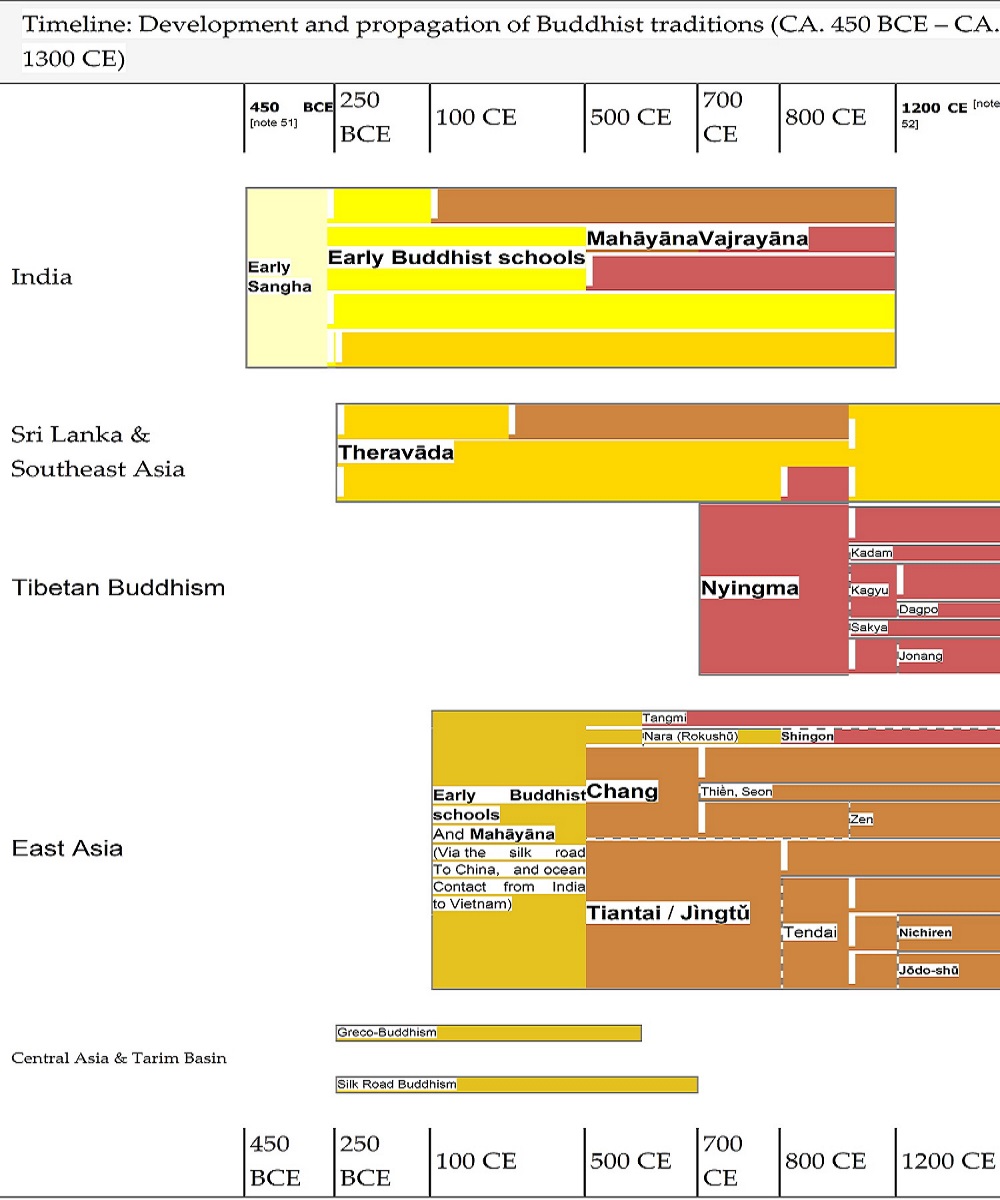
Like different religions, there are also various communities in the Buddhism. After the death of Buddha, various conflicts among his students began, and for the solution of these problems, several meetings were arranged. After these sessions, a separate community emerged in Buddhism. In the beginning, several different communities were formed, but after some time, they were combined with some other communities. Other than that when Buddhism reached in several different cities or areas, it formed some other sort of religion. Due to the concepts of various philosophical thoughts, the various communities of the Buddhism were established.
Let’s take a general view of the Buddhist community through the following map; then we will discuss only two major communities out of all:
This is a rough timeline of the development of the different schools/traditions: 35
Theravada School
The meaning of Theravada is, “the teachings of Elders.” Theravada Buddhism is the more conservative of the two major division within this religion. As such, it is believed to be closer to the original teaching of the Buddha. According to Theravada Buddhism, people must work out their salvation without reliance upon the gods or any force beyond themselves. For this reason, the monk is the ideal figure. It is he who shaves his head, puts on the coarse yellow robe, takes up a begging bowl, and goes forth to seek release from life. His Home is the Sangha just as it was in the days of the Buddha. When a monk achieves the goal he is seeking, he becomes a saint, and it only remains for him to die before he attains Nirvana and release from the cycle of birth, death, and rebirth, which is a common lot of humankind. 36
If a Theravada Buddhism cannot or does not join the Sangha and become a monk, then he must content himself with living the life of a lay person supporting the needs of the monks, and hoping that in another life he will be in the better position to seek to become a saint. The scriptures of Theravada Buddhism are relatively few because scripture is not very relevant in conservative Buddhism.
Thus, Theravada Buddhism, like the Buddhism that Gautama, himself taught, contains little that might be called a religion. The gods, sacrifice, and prayer are of minor consequence. However, certain religious elements have evolved. For example, relics of the life of the Buddha have become important to Theravada. His bones and possessions have become objects of veneration at many of the important sites of Theravada life.
Mahayana School
In the third century B.C, while King Asoka was spreading the gospel of Buddhism using his missionary efforts, certain subtle changes began to occur in the religion itself. When these new principles solidified, they produced a Buddhism so different from that which Gautama taught and which was accepted by the Theravada Buddhists that it was virtually a new religion.
One of the basic assumptions underlying these new developments was that in addition so what the Buddha had taught his disciples openly, there were many other principles that he had taught in secret and which were only for the elect who could properly interpret them. A favourite story of the Mahayanists is that as the Buddha was teaching, he took a handful of leaves from the floor of the forest and explained to his disciples that as the leaves in his hand were less that the total leaves of the forest, so were the teachings he had given them openly less than the full amount of truth that could be given in secret. Mahayana Buddhism simply picked up a few more leaves. Once this assumption was accepted, then all manner of new teaching could be added to Buddhism.
A second principle that began to develop in Mahayana Buddhism between the third century B.C. and the first century A.D. was that Gautama was more that a man. In contrast to the original teaching of the Buddha and those of the Theravada school, Mahayanists began to teach that the Buddha was a compassionate divine being who came to earth in the form of a man because he loved humankind and wished to be of assistance.
The third principle the Mahayanists put forth was that Gautama was not the only Buddha. If Gautama were a divine being who had come to earth to help people, the Mahayanists maintained that there must have been other such beings. Some of these beings had come before Gautama, some had come after him, and some were yet to come. The new idea did more than anything else to broaden the appeal of Buddhism. If many divine beings are compassionate and have come to earth to help suffering people, then these beings are worthy of worship. Whereas Gautama had been unconcerned about the gods, and worship had meant nothing in his scheme of things. The Mahayana Buddhists could now develop worship around these many divine beings. They could study the lives of these new gods and build temples to them Priests could be trained in worshiping these gods, and cultic systems of ritual, sacrifice, hymns, and so on, could be raised on their behalf. The discovery of many compassionate Buddhas was the most religious step ever taken in Buddhism. What had essentially been a philosophy based upon self-help now was free to become a religion in every sense of the word. 37
Festivals
There are many special or holy days held throughout the year by the Buddhist community. Many of these days celebrate the birthdays of Bodhisattvas in the Mahayana tradition or other significant dates in the Buddhist calendar. The most important celebration happens every May on the night of the full moon when Buddhist all over the world celebrates the birth, enlightenment, and death of the Buddha over 2,500 years ago. It is known as Buddha Day or the festival of Wesaqah. Magha Pouja and Eshalah Pouja are also very famous among them. Let’s discuss a few of them in upcoming lines:
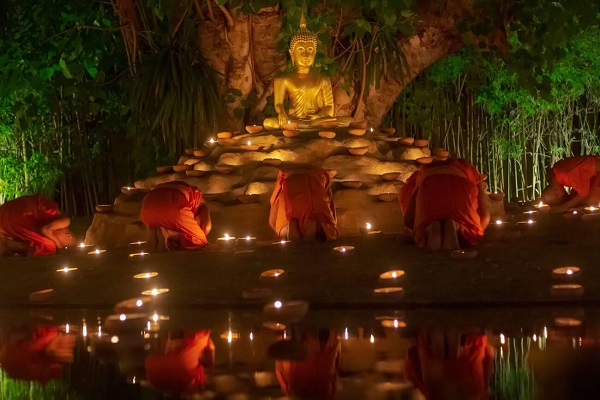
The Buddhist canon prescribes the following festivals and fasts:
Uposatha
The Uposatha days owed their existence to the ancient Vedic custom of holding sacred two periods in each month – the times of the new moon (Darsa) and the full moon (Purnamasa). These feasts, or sacred, days were called Upavasatha, and offerings of intoxicating some were made in connexion with the worship of the moon. According to Buddhist tradition, the monks of non-Buddhistic sects were accustomed to meet in the middle and at the close of every half-month to proclaim their new teaching in public. At such times the people gathered together, and the different sects found their opportunity of increasing their numbers and influence. The Buddhists adopted the custom of these periodical gatherings but confined themselves to meet twice in each month. In later times the intermediate quarter moon days were also held sacred, and so the number of Uposatha days was increased to four in every month.
Vassa
Throughout his whole career, Gautama was in the habit of travelling about during most of the fine part of the year, teaching and preaching to the people. However, during the rainy flour months, from June to October, he remained in one place, devoting himself more particularly to the instruction of his followers. Vassa was ordained because the people complained to Gautama that the Buddhist priests were going on the travels alike during winter, summer, and the rainy season, so crushing the green herbs in the field, hurting vegetable life, and destroying the life of many small living things. The institution of Vassa was Gautama’s answer to these complaints.
The periods fixed by Buddha for entering upon Vassa were two: the earlier and later. The previous time for entering (upon Vassa) is the day after the full moon of Asalha (June-July); the latter, a month after the full moon of Asalha. The double period was probably due to a similar double period prescribed in the Brahmanas and Sutras for most of the Vedic festivals.
The rules for the celebration of Vassa are contained in the third Khandhaka of the Mahavagga. No Bhikkhu was to go on his travels till he had kept the Vassa during the earlier or later three months. By order of a king, the retreat might be commenced at the later period. A Bhikkhu might leave his Vihara if sent for, but not for a longer period than seven days. A number of other cases are given, such as a visit to the father, mother, a relative, or a sick man, in these cases, leaves absence was permissible. However, it was restricted to seven days. The place of retreat could be changed for such reasons as danger from beasts of prey, snakes, robbers; demons want of food, fire, no proper medicine and so on. For those who entered upon Vassa in the later period, the end of the retread fell on Komudi day, i.e. the full moon day in the month Karttika, frequently called ‘Kaumuda day’ in epic literature.
Pavarana
This solemn termination of the Vassa is inaugurated by an act of the Sangha, in an assembly of the chapter of at least five monks. The fourteenth and fifteenth days of the half month were appointed as Pavarana days. The ritual of the ceremony forms the fourth Khandhaka of the Mahavagga.
Kathina
Immediately after the Pavarana, there followed a distribution of robes, which believers offered to the fraternity, to the bhikkhus composing the Sangha. The ceremonies are detailed in the seventh Khandhaka of the Mahavagga. The distribution commences with the Kathinatthara; atthara, spreading out, not being here used literally, for spreading out on the ground or otherwise, but in a secondary, Juristic sense. The term is translated according to context, sometimes as ‘spreading out’, at times by ‘ceremony,’ and sometimes into ‘dedication.’
The seasons
At the time of his ordination, each priest received from the master of the ceremonies, kammachari, five ordinances, the second being ‘the seasons.’ In ancient India, the ritual year was divided into three four monthly periods, the three terms being celebrated with sacrifices, on the full moon day of Phalguna, of Asadha, and of Karttika; or, in each case, one month later, as described above. These three sacrificial festivals inaugurated summer, the rainy season, and winter. The Buddhists retained this division of the year and celebrated the terms, but of course, not with sacrificial rites. During the first period the priests were directed to reside at the roots of trees, to have the advantage of silent and profound meditation; during the second to keep Vassa; and during the third to occupy pannasalas (huts of leaves and branches), for mutual instruction and for reading the bhana to the people.
Sangitas
Convocations of priests were directed to be frequently held. The Pali word is from a root which signifies ‘tossing,’ or ‘to sound,’ as Indians do when they read sacred books. From this, it appears that the object of these assemblies was to read the bhana to each other, but particularly to read and expound the Vinaya books. 38
That is the basic information about Buddhism. The next section will discuss Buddha’s prophecies about the Hoy Prophet  .
.
- 1 Gotama is the family name, and Sākya is the name of the race to which the Buddha belonged.
- 2 Narada Mahathera (1998), The Buddha and His Teachings, Buddha Educational Foundation Taipei, Taiwan, Japan, Pg. 3.
- 3 Anguttara Nikaya (2010), Part-1, Translated by Nyanaponika Thera and Bhikkhu Bodhi, Buddhist Publication Society, Kandy, Sri Lanka, Pg. 22.
- 4 Narada Mahathera (1998), The Buddha and His Teachings, Buddha Educational Foundation Taipei, Taiwan, Japan, Pg. 5-11.
- 5 It is a Pali word (which is a Prakrit language native to the Indian subcontinent. It is widely studied because it is the language of much of the earliest extant literature of Buddhism as collected in the Pali Canon or Tipiṭaka and is the sacred language of Theravada Buddhism) commonly translated as meditation, is a state of no mind. It is being used in Hinduism, Buddhism and Jainism. In Buddhism, it is a series of cultivated states of mind, which lead to "state of perfect equanimity and awareness”.
- 6 Kauṇḍinya (Sanskrit; Pali: Koṇḍanna) was a Buddhist monk follower of Gautama Buddha and the first to become an arhat (one who is worthy or as a "perfected person" having attained nirvana. Other Buddhist traditions have used the term for people far advanced along the path of Enlightenment, but who may not have reached full Buddhahood. (Rhie, Marylin; Thurman, Robert (1991), Wisdom and Compassion: The Sacred Art of Tibet, Harry N. Abrams, New York, USA (with 3 institutions)). He lived during the 6th century BCE in what is now Uttar Pradesh and Bihar, India.
- 7 Gyatso, Geshe Kelsang (2007), Introduction to Buddhism An Explanation of the Buddhist Way of Life, Tharpa, U.K & USA, Pg. 8-9.
- 8 Anderson, Carol (1999), Pain and Its Ending: The Four Noble Truths in the Theravada Buddhist Canon, Routledge (Notes), Abingdon, U.K., Pg. 411.
- 9 Moksha also called vimoksha, vimukti and mukti, is a term in Hinduism and Hindu philosophy which refers to various forms of emancipation, liberation, and release (John Bowker, The Oxford Dictionary of World Religions, Oxford University Press, Oxford, U.K, Pg. 650.). In its soteriological and eschatological senses, it refers to freedom from Saṃsara, the cycle of death and rebirth. In its epistemological and psychological senses, moksha refers to freedom from ignorance: self-realization and self-knowledge. (E. Deutsch (2001), The self in Advaita Vedanta, in Roy Perrett (Editor), Indian philosophy: metaphysics, Taylor and Francis, Abingdon, U.K, Vol. 3, Pg. 343-360.)
- 10 Vetter, Tilmann (1988), The Ideas and Meditative Practices of Early Buddhism, New York, USA, Pg. XXI-XXXVII.
- 11 Nirvana is the extinguishing of the "fires" of desire, hatred, and ignorance that keep the cycle of suffering and rebirth going. Literally, it means “blowing out” or “becoming extinguished, ” as when a flame is blown out or a fire burns out. ("Nirvana". Encyclopedia Britannica. Retrieved 09-12-2016.) Nirvana is also regarded as the "end of the world", in that no personal identity or boundaries of the mind remain.
- 12 Christmas Humphreys (1962), Buddhism, Penguin Books, Harmondsworth, London, U.K, Pg. 132-134.
- 13 The Buddhist Review: https://tricycle.org/magazine/the-first-sermon-of-the-buddha/: Retrieved: 09-12-2016
- 14 Imran Nazer Hussain (1999), Islam And Buddhism in the Modern World, The Muslim Converts’ Association, Singapore, Pg. 10-12.
- 15 Encyclopedia Britannica (Online Version): https://www.britannica.com/topic/Buddhism: Retrieved: 12-02-18
- 16 E. A. Burtt (1955), The Teaching of The Compassionate Buddha, The New American Library, New York, USA, Pg. 27-29.
- 17 See, for instance, Buswell (2003): "Rank(s) among the best-known Buddhist texts" Pg. 11; and, "One of the most popular texts with Buddhist monks and laypersons" Pg. 627. Peter Harvey (2007) (2nd edition), Pg. 459-460, writes: "Its popularity is reflected in the many times it has been translated into Western languages"; Brough (2001), Pg. xvii, writes: "The collection of Pali ethical verses entitled "Dhammapada" is one of the most widely known of early Buddhist texts."
- 18 Imran Nazer Hussain (1999), Islam And Buddhism in the Modern World, The Muslim Converts’ Association, Singapore, Pg. 5.
- 19 Buddhism and the God-Idea: http://www.buddhanet.net/e-learning/qanda03.htm: Retrieved: 10-12-2016.
- 20 Lewis Moore, Encyclopedia of World Religions (translated), Nigar Shah, Lahore, Pakistan, Pg. 226.
- 21 Joseph Gaer (1958), The Wisdom of the Living Religions, Skeffington, London, U.K, Pg. 16-20.
- 22 Reginald A. Ray (1994), Buddhist Saints in India, Oxford University Press, Oxford, U.K, Pg. 282.
- 23 Reginald A. Ray (1994), Buddhist Saints in India, Oxford University Press, Oxford, U.K, Pg. 265.
- 24 Dhutanga is a group of thirteen austerities or ascetic practices most commonly observed by the practitioners of the Thai Forest Tradition of Theravada Buddhism.
- 25 Parami and paramita are both Pali terms which means "perfection" or "completeness", Pali literature makes far greater reference to parami.
- 26 Prajnaparamita means "the Perfection of (Transcendent) Wisdom" in Mahayana Buddhism. Prajnaparamita refers to this perfected way of seeing the nature of reality, as well as to a particular body of sutras and to the personification of the concept in the Bodhisattva known as the "Great Mother" (Tibetan: Yum Chenmo). The word Prajnaparamita combines the Sanskrit words prajna "wisdom" with paramita "perfection". Prajnaparamita is a central concept in Mahayana Buddhism and is generally associated with the doctrine of emptiness (Shunyata) or 'lack of Svabhava' (essence) and the works of Nagarjuna. Its practice and understanding are taken to be indispensable elements of the Bodhisattva path.
- 27 Gyatso, Geshe Kelsang (1995), The Bodhisattva Vow (2nd. ed., 1995), A Practical Guide to Helping Others, Tharpa Publications, U.K & USA, Pg. 4-12.
- 28 The ‘Bodhisattva Vow’ is the vow taken by Mahayana Buddhists to attain complete enlightenment for the sake of all sentient beings. One who has taken the vow is nominally known as a Bodhisattva.
- 29 Rupert Gethin says: "(Karma is) a being’s intentional 'actions' of body, speech, and mind—whatever is done, said, or even just thought with definite intention or volition"; "(a)t root karma or 'action' is considered a mental act or intention; it is an aspect of our mental life: 'It is "intention" that I call karma; having formed the intention, one performs acts (karma) by body, speech and mind.'" (Gethin, Rupert (1998), Foundations of Buddhism, Oxford University Press, Oxford, U.K, Pg. 119-120.)
- 30 Peter Harvey (2013), An Introduction to Buddhism, Cambridge University Press, Cambridge, U.K, Pg. 40.
- 31 Gombrich, Richard F. (1997), How Buddhism Began, The Conditioned Genesis of the Early Teachings, Munshiram Manoharlal Publishers Pvt. Ltd., New Delhi, India, Pg. 51.
- 32 Gombrich, Richard (1996), Theravada Buddhism, A Social History from Ancient Benares to Modern Colombo, Routledge, Abingdon, U.K, Pg. 68.
- 33 For example, the Sautrantika, a subsect of the Sarvastivada, the most important of the early Buddhist schools, regarded the intention to be the stimulus for karma, action which leads to consequences. The Vaibhaṣika, the other sub-sect of the Sarvastivada, separated the intention from the act, regarding intention as karma proper.
- 34 Nibbana: http://www.accesstoinsight.org/ptf/dhamma/sacca/sacca3/nibbana.html: Retrieved: 16-12-2016.
- 35 Wikipedia the Free Encyclopedia: https://en.wikipedia.org/wiki/Buddhism: Retrieved: 16-12-2016.
- 36 Lewis M. Hopfe (1979), Religions of the World, Glencoe Publishing Co. Inc, Ohio, USA, Pg. 132.
- 37 Lewis M. Hopfe (1979), Religions of the World, Glencoe Publishing Co. Inc, Ohio, USA, Pg. 134-135.
- 38 James Hastings (1912), Festivals and Fasts (Buddhist), Encyclopedia of Religion and Ethics, T.& T. Clark, New York, USA, Vol. 5, Pg. 836-837.
Hamdani, Mufti Shah Rafi Uddin & Khan, Dr. (Mufti) Imran. (2018), Buddhism – Doctrines, Sacred Texts, and Important Traditions, Encyclopedia of Muhammad ﷺ, Seerat Research Center, Karachi, Pakistan, Vol. 1, Pg. 759-790.
https://muhammadencyclopedia.com/article/en/buddhism-doctrines-sacred-texts-and-important-traditions