
Zoroastrianism – Faith, Sacred Texts and Ritual Practices
Published on: 09-May-2026Zoroastrianism takes its name from its founder, the Persian Zarathustra, who was probably a contemporary of Ezekiel  . The earlier religion of Persia was based on Polytheism of the usual Indo – European type. According to this belief, gods are thoroughly individual and were originally nature spirits personified and raised to the rank of “high gods”. 1 It presents a clear picture of life after death, either of bliss or suffering, and the enjoyment of the former and the avoidance of the latter constitute the chief ideal of the religion. Sin is in some of its forms the violation of the moral law of conscience, and in this connection, the religion has developed a high standard of morality.
It became the common religion of Iran and notably was the state religion under the Sasanian dynasty (A.D. 211-640). It is still professed by the Parsis of Bombay and by some sporadic communities in Persia. Zoroastrianism is considered as one of the interesting religions of the world. Its doctrines and rites are well known either in their present form or as they are to be found in the Pahlavi books and the Avesta.
Zoroastrianism was suppressed from the 7th century onwards, following the Muslim conquest of Persia of 633-654. Besides the Zoroastrian diaspora, the older Mithraic faith Yazdanism is still practised amongst the Kurds.
Zoroaster
There is much obscurity concerning the person of the founder, the time and the place of his preaching. Zoroaster, who conceived a new religion, the dates of his birth and death are commonly given as 660 and 583 B.C., though some scholars, with good reason, believe that Zoroaster might have lived many centuries earlier, even as early as 2000 B.C. 2
Although the Avesta is the Zoroastrian Bible, it is quite certain that only a small portion of the book can probably be regarded as the work of a prophet. That portion is the Gathas, or versified preaching’s, written in a dialect slightly different from the language of the rest of the Avesta. In the Gathas, Zoroaster appears as a very real and human personality, devoid of all the marvellous features which surround him in later literature. He is presented there as the son of Pourushaspa of the Spitama family. For ten years, he had only one disciple, Maidhyoimaonha, his cousin. At last, he converted to his doctrine Vishtaspa, a local prince. However, the Gathas shows that much resistance still was offered to Zoroaster, who in some places, exhibits signs of anxiety. He had undertaken to reform not only the beliefs, but also the social habits of the tribes of Eastern Iran, among which he had settled. His desire was to deter them from nomadic life and induce them to devote themselves to husbandry. According to tradition, Zoroaster had come from Western Iran (he is represented as a native of Rages in Media), a region which was more advanced in civilization. He was, so it seems, trying to introduce the Western customs into the wilder districts of the East.
Zoroaster was a Magian who, no doubt, rebelled against the practices of the majority of the members of his corporation. The Magi of Persia gradually adopted a form of Zoroastrianism combined with less exalted beliefs. In this way, the name of Zoroaster was attached to Magians and magic by the Greeks, who do not seem to have had—at an ancient period—any clear idea of his teachings and real personality. 3
Zoroaster‘s reforms
According to Zoroastrian belief, when Zoroaster was 30 years old, he went into the Daiti River to draw water for a Haoma ceremony. When he emerged, he received a vision of Vohu Manah. 4 After this, Vohu Manah took him to the other six Amesha Spentas, 5 where he received the completion of his vision. This vision radically transformed his view of the world, and he tried to teach this perspective to the others.
It is precisely the originality of Zoroaster's reform to have rejected all the 'other gods', including those two prominent deities who later found their way back into Zoroastrianism. The use of representations of the gods and the practice of burial are other un-Zoroastrian features, so that one is impressed equally by the striking resem-blances and, the essential differences between the two creeds.
There are many abstractions in the Veda about God. It is clear that Zoroaster has combined with a coherent ethical system data which he found around him, transmitted in the teachings of the sages of Iran as well as of India. By comparing the religion of the Gathas with that of the oldest Vedic hymns and with what is known of the current beliefs of ancient Iran one can form an idea of Zoroaster's originality.
The Vedas knew of two series of gods:
- The Devas: sky, light, storm, etc., i.e. gods as powers of nature (sensuous deities.).
- The Asuras, or gods in their relation to men as protectors of morality, inspiring awe, reverence, and fear. Varuna, the great Asura, was the ethical god par excellence.
In later times, the term Asura came to be used of dreaded deities and evil spirits (the moral aspect of divinity with the Aryans was mostly associated with the cult of the souls— e.g., in the Great Erinyes), while the devas became the real gods.
Zoroaster is evidently a radical reformer wishing to extricate the strict monotheism which existed potentially around him from all the concessions which it was making to tradition and to rid man completely, from all allegiance to deities implicated in magic.
In Zoroaster's writings their moral meaning is always the real one, unmistakable for the initiated devotee, but at the same time, there is in many passages an allusion to the material aspect of the hypostasise so that sometimes the text has both an esoteric and an exoteric meaning.
In everything, thus, the reform of Zoroaster appears to us as purification, a spiritualization of the beliefs current at the time among both the sages and the people. It is also systematisation. The preacher has built up a coherent religious doctrine out of elements provided by a tradition in which the ethical element was predominating. 6
Philosophy of Zoroaster
In the Gathas, Zoroaster sees the human condition as the mental struggle between asa (truth) and druj (lie). The cardinal concept of asa—which is highly nuanced, and only vaguely translatable—is at the fundament of all Zoroastrian doctrine, including that of Ahura Mazda (who is asa), creation (that is asa), existence (that is asa) and as the condition for free will.
The purpose of humankind, like that of all other creation, is to sustain asa. For humanity, this occurs through active participation in the life and the practice of constructive thoughts, words and deeds.
Elements of Zoroastrian philosophy entered the West through their influence on Judaism and Middle Platonism and had been identified as one of the key early events in the development of philosophy. 7 Among the classic Greek philosophers, Heraclitus is often referred to as inspired by Zoroaster's thinking. 8
In 2005, the Oxford Dictionary of Philosophy ranked Zarathustra as first in the chronology of philosophers. 9 Zarathustra's impact lingers today due in part to the system of rational ethics, he founded called Mazda-Yasna. The word Mazda-Yasna is Avestan and is translated as "Worship of Wisdom" in English. Zoroastrians later educated the Greeks, who used a similar term, philosophy, or “love of wisdom,” to describe the search for ultimate truth.
Zoroaster emphasised the freedom of the individual to choose right or wrong and personal responsibility for one's deeds. This personal choice to accept asa or arta (the divine order), and shun druj (ignorance and chaos) is one's decision and not a dictate of Ahura Mazda. For Zarathustra, by thinking good thoughts, saying kind words, and doing good deeds (e.g. serving the needy or doing good works), we increase this spiritual force asa or arta in the world and ourselves. We celebrate the divine order, and we come to a step closer to the everlasting road to being one with the Creator. Thus, we are not the slaves or servants of Ahura Mazda, but we can make a personal choice to be his co-workers, thereby refreshing the world and ourselves.
Death of Zoroaster
According to the tradition, he lived for many years after Vishtaspa conversion, managed to establish a dedicated community, and married three times. First, two wives bore him three sons and three daughters. His third wife Hvovi was childless. 10
According to tradition, Zoroaster died when he was 77 years and 40 days. The following Pahlavi sources like Shahnameh, however, claim an obscure conflict with Tuiryas people, in which Zoroaster was murdered by Kara pan (old religion priest) Bradres. 11
Major Holy Books
The holy and authentic book of the Parsis is the “Avesta”. The basis of the religion is upon this book, and the rituals are also recited from this book. Besides, there are other books other than Avesta considered very significant.
Zend Avesta
The Avesta, the sacred book of ancient Iran, contains the teaching of Zoroaster. It serves as the holy scriptures of Parsis and the so-called Gabars of Persia at the present day. Although fragmentary in its current form, the Avesta is one of the great religious monuments of antiquity. It preserves the records of faith that were once among the most magnificent in the Orient, and that might well have spread through Europe in early ages. Nevertheless, for the victories of the Greeks over the Persians at Marathon, Plataea, and Salamis, and for the triumphal incursion of Alexander enter into the East.
The Avesta in its present form consists of the following divisions: (a) Yasna, including (b) the Gathas, (c) Visparad, (d) Yashts, (e) Minor Texts, such as Nyaishes, Gahs, etc., (f) Vendidad, (g) Fragments.
These divisions fall naturally into two groups:
- The first group comprises the Vendidad, Visparad, and Yasna, which are classed together for liturgical purposes. In the ritual, these are not recited as separate books, but intermingle with one another, and the manuscripts often present them in the order in which they are to be used in the service. In this case, the Pahlavi translation is omitted, and the collection is called Vendidad Sadah, ‘Vendidad Pure,’ that is, without commentary. On the other hand, these books also appear in some manuscripts as separate entities, and in that case, each part is usually accompanied by a rendering in Pahlavi.
- The second group comprises the Minor Prayers and the Yashts, which are often included with these in the manuscripts, and is called Khordah Avesta, ‘Abridged Avesta,’ or ‘Small Avesta.’ This forms a species of prayer-book for the congregation. 12
An important book “Denkard” states that Avesta had many other parts as well, but they are not available now. The sources of the present Avesta are also unknown. It is also said that the name of the book is Zend which is famous by the name, Avesta.
Denkard
The Denkard (‘Acts of the Religion’), dating from the 9th C., and forming ‘an extensive collection of information regarding the doctrines, customs, traditions, history, and literature of the Mazda-worshipping religion’, is the chief source for a knowledge of Zoroastrian philosophy of the Sasanid period. It also contains much legendary material of value, such as the traditions concerning Zoroaster, contains summaries of the Avesta, including accounts of those large portions which are no longer extant. 13
Dasatir
After the Avesta, the Dasatir is considered the second most sacred holy book of Zoroastrianism. It consists of fifteen scriptures which are linked to fifteen different prophets. According to the traditions, they belonged to an ancient era. This book teaches about animism and monotheism.
Shahnameh
Shahnameh means about the Shah. This book is a valuable treasure of the Persian Literature, but it also holds great importance in Zoroastrianism. The reason for its fame is the confab of the personalities mentioned in the book who were great followers of Zoroaster. This book is a poetry collection written by the Persian poet Firdausi (940-1020 CE). This collection illuminates the ancient Iran to the Islamic rule and tells us about its cultural and intellectual history. This collection comprises of about sixty thousand verses.
Middle Persian/Pahlavi
Middle Persian and Pahlavi works created in the 9th and 10th century contains many religious Zoroastrian books, as most of the writers and copyists were part of the Zoroastrian clergy. The most significant and important books of this era include the Denkard, Bundahishn, Menog-i Khrad, Selections of Zadspram, Jamasp Namag, Epistles of Manucher, Rivayats, Dadestan-i-Denig, and Arda Viraf Namag. All Middle Persian texts written on Zoroastrianism during this period are considered secondary works on the religion, and not scripture. However, these books bear a substantial influence on the faith.
Principal beliefs and concepts
The religious thought of the ancient Iranians is based on the opposition between order and chaos, good and bad, truth and falsehood, as manifested in the thought, speech, and activity of gods and men. Many aspects of the earliest beliefs of the Iranians can be retrieved from the Avesta and the Old Persian inscriptions, supplemented by information provided by the Greek authors. While later beliefs are spelled out in greater detail in the Pahlavi texts (for instance, in the Bundahishn, the “establishment in the beginning”). The following is an overview based primarily on the Avestan texts.
The world order (Asha)
Ahura Mazda’s world was ordered according to the principle of (micro/macro) Cosmic Order (Avestan Asha), which is manifested in the light of day, the diurnal sky, and the sun. It is one of the most important concepts in the old Indo-Iranian poetry and its mythical world of reference. In this, the term is rendered as “Order” and its derivatives accordingly: ashawan “Sustainer of Order” (“detainer or upholder of Order” is also possible).
The “Order” probably originated by a “thought” of Ahura Mazda’s and was imposed on the cosmos by him when it was first established. It was also Ahura Mazda who, by his thought, made the luminous spaces of Order, which are the bright diurnal sky. In fact, Order contains the sun, and in the Young Avesta, the sun is said to be Ahura Mazda’s eye. Ahura Mazda is said to be the father of the Order, and he upholds it. The term asha thus has three primary references in the Old Avestan texts:
It has been common practice to translate Asha (rta) as “truth,” but in the Avesta and later texts Asha (and later forms) is never used in expressions such as “speak the truth.”
The (new) world/existence (Ahu)
To the Old Iranian poet-sacrificer, existence is divided into different types of “states” of existence. In time, there are three: the first; the current (with its past, present, and future); and the last states. In space, there are two: that “with bones” or that “of living beings,” which is that of man, the world in which we live, and that “of the thought,” which is that in which the gods and the dead dwell. All these states can be “good” or “bad.” The first good existence is the condition of the ordered cosmos, while the first evil presence corresponds to the first attack. The last existence, as related in the Old Avesta, refers to the dead, who will go to a good (the best) or a bad (the worst) existence, in accordance with their behaviour in the world. Both the first and the last existences are unique, as opposed to the past, present and future ones of (mankind), which are recurring phenomena.
The poet-sacrificer and his people are in charge of these recurring existences, their “job” being to make each one of them be like the good first existence. Their rivals and adversaries, on the other hand, are responsible for the decline—the sickening and destruction—of each of the present existences, thus making the regeneration and revitalization of the existence necessary.
The two worlds
The ordered world is divided into two spheres: the world (existence) of thought and the world with bones or the world (existence) of living beings. The world of thought contains what humans can only apprehend by thought, while that of living beings includes what can be perceived using the senses (seeing, hearing, and feeling).
Zoroastrianism is therefore characterised by a double duality: between the original good and evil principles and between the “created” worlds of thought and living beings. The principle of Order applies to both the world of thought and that of living beings. In the former it applies to the cosmic processes, established and upheld by Ahura Mazda; in the latter, it applies to the behaviour of men, both in daily life and in the ritual. All entities in the universe, including humanity that conform to this principle, are said to be “Sustainers of Order” or “Orderly” for short (ashawan). 15
The Gods
Ahura Mazda
Ahura Mazda, by his thought (and words and actions) first ordered the cosmos and still upholds the actual/real Cosmic Order, the visible image of which is the day-lit sky with the sun as its centrepiece. Ahura Mazda is also the one who engendered many of the elements in the cosmos, and he is its ruler. His two epithets, Ahura and Mazda, which also make up his name, refer to these functions. In the Gathaa, these epithets are still independent of one another, although either of them is likely to be followed by the other in the same strophe. In the Young Avesta, Ahura Mazda is the name of the divinity, and whether there still was a feeling for what the words originally meant is uncertain. By the Achaemenid period, the univerbation process was complete, and the name appeared as Ahuramazda, which in turn became Parthian and Middle Persian Ohrmazd, Ohrmazd, and, still later, Hormazd. 16
Ahura Mazda is closely associated with the six “Life-giving Immortals.” These were originally parts of Ahura Mazda’s sacrifice, but then became deities in their right. They are still more complex entities, however, as they also represent parts of the cosmos and serve as “guardians” of things in this world.
The life-giving immortals
No gods other than Ahura Mazda are mentioned by name in the Gathas and the Yasna Haptanghaiti. However, Airyaman is invoked in the A Airyama ishiyo prayer, which concludes the gate collection, and several physical entities are invoked as divinities in the Yasna Haptanghaiti, among them the holy fire and the holy waters. Instead, in the Old Avesta, we find a number of concepts with a divine status that we would term “abstract” (human senses, emotions, etc.).
In the Young Avesta, the first six constitute a fixed series: Vohu Manah, Asha Vahishta, Khshathra Vairiya, Spenta Armaiti, Haurvatat and Amertatat. Sraosha is a warrior god whose assigned task is to protect Ahura Mazda’s creation against the forces of darkness, especially wrath, and presides over the punishment of sin in the hereafter. Ashi a goddess who protects Zarathustra in his battle with the Evil Spirit. Prefixed by Ahura Mazda, this group of “entities” constituted the Seven Amesha Spentas, the seven “Life-giving Immortals,” one of the cornerstones of the post-Gathic Zoroastrianism. Of these, Armaiti, daughter and wife of Ahura Mazda, is also the genius of the Earth, a connection that is Indo-Iranian.
Life-giving humility (Spenta Armaiti, Pahlavi Spandarmad)
Armaiti, Humility, is the daughter of Ahura Mazda. Already in the Old Avestan texts, she is the deity of the Earth, as she is in the later Avestan texts and several other Old Iranian mythologies (Persian, Sogdian, Khotanese). She is, therefore, the counterpart of the celestial Order, with which she is frequently associated, and this couple, therefore, corresponds loosely to the Old Indic couple Heaven and Earth.
Fire (Atar, Pahlavi Adur and Atash)
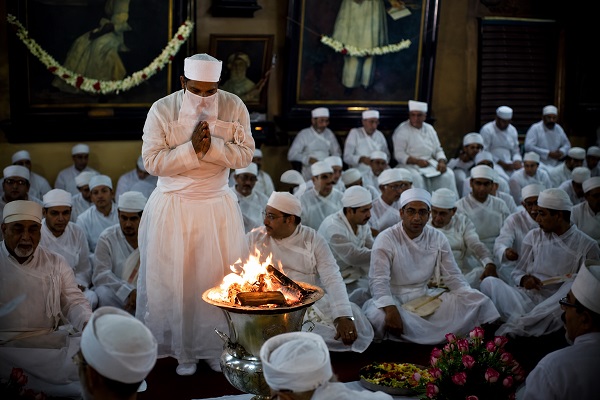
The sacrificial fire belongs to Ahura Mazda (in the Young Avesta it is the son of Ahura Mazda), the messenger who goes between the worlds of thought and living beings, bringing the offerings of the worshipper to the gods and the gifts of the gods to the worshipper.
Other Gods
In the Young Avesta, sacrifices and worship are offered to a number of deities. Among them Mithra, the sun god; Anahita, the heavenly river; Vayu, the god of the intermediate space between the spherical heaven and the earth suspended in its centre; Tishtriya, the Dog Star, who fights the Demon of Drought to release the rains; etc.
Evil gods and demons
Ahura Mazda’s opponents are the Cosmic Deception, or the Lie (drug, druj), and her principal agent, the Evil Spirit (Angra Manyu, literally, “the dark, black spirit/inspiration”), whose creations and followers tell lies about Ahura Mazda and his Ordered universe. They are therefore said to be “filled with/possessed by the Lie, Lieful,” (drug-want). When Ahura Mazda established the Ordered Universe, sunny and healthy, the Evil Spirit, in turn, polluted it with all kinds of evil things, darkness, death, sickness, etc. The agents of the Evil Spirit are the old (Indo-Iranian) gods, the devas, or demons. These are the old Indo-Iranian (and Indo-European) celestial gods, who were demoted in Iran, where they were assigned to the world governed by the Lie. In the myth, their demotion was caused by their making the wrong choices.
This feature, in particular, distinguishes Zoroastrianism from Indic (and Indo-European) beliefs. The fact that the Avestan devas and Old Persian devas are no longer beneficent heavenly beings, but rather the agents of chaos, deception, and evil, has been explained by scholars variously. Most commonly, it has simply been assumed that the reversal of the fortunes of the devas was the work of a single man and due to a conscious and planned departure from earlier beliefs. That man, they decided, must have been Zarathustra, and the “new” beliefs must have been part of his “reform” of the traditional religion.
The others
Aeshma: “Wrath”, the principal opponent of Sraosha; he probably personifies nocturnal darkness and the night sky, and his “bloody club” may refer to the sunset, in which the sun seems to be sinking into the blood.
Nasu: The Carrion demoness, the greatest polluter of Ahura Mazda’s world.
Bushyansta: The demoness of sloth, with long fingers, who keeps telling men “there will be another (day)” and not to bother to get up in the morning to do Ahura Mazda’s work.
Both Ahura Mazda and the Evil Spirit have their agents among the humans. Ahura Mazda’s principal agent, the first being to “praise Order,” to “discard the devas” as not worthy of sacrifice, and to “sacrifice to Ahura Mazdâ” were Zarathustra, the first human poet-sacrificer. Later poet-sacrificers imitate Zarathustra to perform a successful sacrifice. Zarathustra’s primary adversaries in the Gathas are the kawis and kirpans.
The cow
The cow plays a vital role in the world of the Old Avestan poet. She represents his subsistence, providing many of the things necessary for his and his family’s survival, as well as for the ritual. Having many cows is a guarantee of well-being and a symbol of being favoured by the gods. Hence, the object of revitalising Armaiti, the earth, is to ensure peace and pasture, without which no stable human community is possible. Ahura Mazda created the cow, but, no special rate was provided for her within the original scheme of the Order established during the first existence. Hence, she has no human protector and provider of forage, only the heavenly Ahura Mazda himself. For this reason, Zarathustra, Ahura Mazda’s favourite poet-sacrificer, is sent down among humans and is instituted as her master and protector and provider of forage.
According to the poet, the cow was thus created and intended for the Sustainers of Order. Social disorder and conflict are therefore to a large extent apparently based on the fact that those whom the poet considers being possessed by the Lie are frequently those who own the most cows and controls the pastures. By these, the cow is apparently mistreated, fettered, and even killed.
The (re) vitalization of the world healing of the cosmos
The Old Iranians viewed the natural processes of time—the change between day and night and summer and winter— as the result of a cosmic battle, fought between Ahura Mazda and the Lie with the assistance of their divine and human followers. The battle was renewed every night and every winter, and its purpose was to reestablish the first state of the cosmos, that is, the way it was when Ahura Mazda first ordered it. Since the daily and yearly changes cause nature to sicken or be destroyed, what is needed to remake the first existence is a good portion of healing and revitalising/ regenerating/ reinvigorating strength. The healing of the cosmos is also the purpose of the Videvdad sade ritual. The healing power of Ahura Mazda and the poet is referred to by the term “Healer of (this) Existence.” The revitalising strength, on the other hand, is the underlying theme of the entire Old Avestan text corpus and religion.
Swelling of the cosmos
When Ahura Mazda and the other immortal gods rule the world according to Order, it is full of life and fecundity. The terms of this state are derived from the root span, which implies “swelling with vital juices.” This may involve the conception of the world as “dried out, deflated,” like trees and plants and the ground itself during periods of non-growth, as opposed to times of growth when nature is reborn and swells with life-giving juices. Similarly, the female breast, deflated during periods of non-fecundity, is inflated with milk before and after birth and the male penis inflated before releasing its fertilising semen. The most important of these words are spenta, which is the epithet of everything that has (at least potentially) the power to “revitalise” the cosmos in this manner. Sawa (h), the “strength” by which the powers of darkness and death can be overcome and the revitalising take place. Saoshyant “(he) who shall make (the existence) spenta, i.e., swell (with the Juices of Life),” that is, the competent and successful poet-sacrificer here and now. Moreover, (according to the Young Avesta) the different future mythical poet-sacrificers, notably the three sons of Zarathustra, who shall have each of them sacrifice at the beginning of the last three millennia to reestablish the first state of existence permanently.
In practice, this refers to remaking the world in its pristine, unsullied form, as established and made in the beginning by Ahura Mazda. The good deities in the world of thought, first of all, Ahura Mazda, are all “life-giving, vitalizing” (spenta), that is, they are responsible for maintaining the universe in its pristine state, as originally established by Ahura Mazda himself. The term is frequently rendered in Western literature as “beneficial” or “holy,” but the latter is a very imprecise term and should be avoided. Humans contribute to this maintenance of the Ordered Universe through their behaviour and their rituals.
At the end of the final battle, the last “life-givers” or “revitalizers” (saoshyants) will stand forth and by their victory over the forces of Evil render the world “juicy” (frasha), that is, full of fertile, juices, as it was in the beginning. In the Gathas, this adjective characterises the supreme exchange gift produced by Ahura Mazda for a successful sacrifice, namely the remaking of the pristine state of the world. The event is also referred to as the “Juicy-making” (frasho.kerti). This term later becomes reserved for the final event, at the end of the world, when Ahura Mazda performs the ultimate sacrifice, producing the permanent “Juicy-making,” a state as “incorruptible, indestructible, undecaying, unrotting, ever-living, ever-swelling.” The term is commonly rendered as “Renovation.” Here it is rendered as “Perfectioning.” 17
Head covering
The Zarathushtri also practice traditional head covering ritual similar to that of Judaism. It is vital to the practice, and according to Hoshang Bhadha: “A Zarathustri is enjoined to cover his head at all times. It is one of the core disciplines for a Zarathustri. If you have ever looked at the pictures of Zarathustris from the past, you will recognise them simply because they were wearing a cap or turban covering their head. If you read the description of Parsis from the past, it is emphatically described that whether a child, female or male they all had their head(s) covered. It is unfortunate that our own community people laugh on us for wearing a cap, which is the foundation of all our religion practices. Needless to say, today a Zarathustri wearing cap will get strange glances; he/she will evoke giggles and some people even consider them as one belonging to the Stone Age. However, such reactions are seldom seen when a Zarathustri will observe a Muslim or Jew demonstrating their practice of covering the head during and out of their prayer area. It is a common sight to see a Zarathustri coming out from the Agiary with one hand over his head, not as respect, but to prepare himself/ herself to remove the cap/scarf before he/she reaches the main gate. Some people feel embarrassed to wear in public, whereas some remove it to protect their hairstyle”. In Zoroastrianism, it is a remedy to protect oneself from the negative thought process (es). 18
Zoroastrian worship
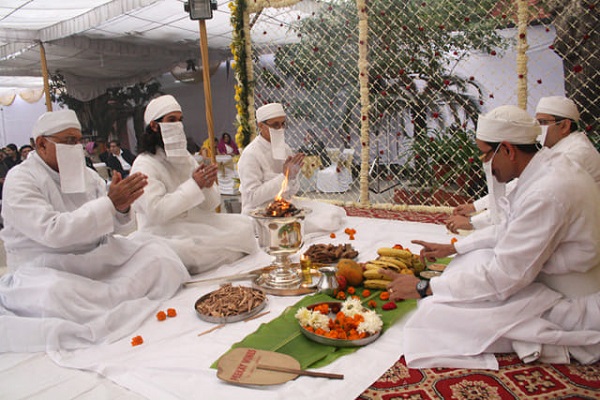
The Zoroastrian temples contain the vessel in which the sacred fire burns. Over it, perfumes are sprinkled from time to time. Five times a day a mobbed priest enters the room. The lower part of his face is covered with a veil (paitidana), preventing his breath from polluting the sacred fire, and his hands are gloved. He lays down a log of sandalwood and recites three times the words duzhmata, duzhukhta, duzhvarshta to repel 'evil thoughts, evil words, evil deeds.' Every Zoroastrian has, moreover, a sacred fire in his own house.
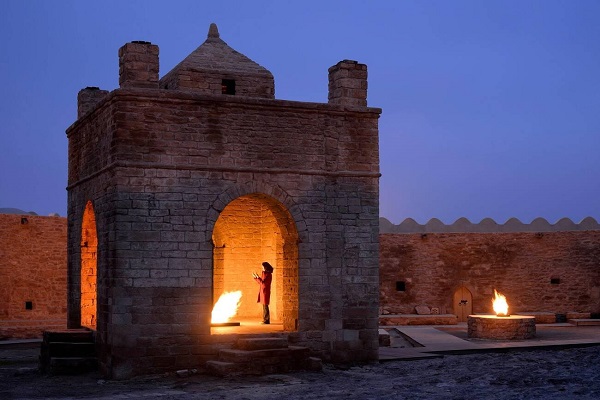
The liturgy includes the daily recitation of a few verses of the Avesta. For this purpose, the sacred book has been divided into short portions which are arranged according to the date on which they must be recited, not according to their natural interrelation, exactly like the Gospels in a Missal. While he recites the prayers, the priest holds in his hands the baresman, or a bundle of twigs.
Each month and each day has its patron. The principal feasts are the New Year (nauroz), the equinoxes consecrated to Mithra, the gahanbars at the change from one season to another, the days of the dead at the end of the year, the days of full moon and new moon. The sacrifice consists of an oblation of bread and myazda. 19 Besides this, there was, despite Zoroaster's ban upon it, the sacrifice of the haoma, an intoxicating plant of which the stems were crushed in a mortar, and the juice strained off; this was presented before the fire and drunk by the officiating priest and his acolytes (raspi). A child at birth has his lips steeped in haoma, but he does not become a full Zoroastrian until, between the ages of twelve and fifteen years, he receives the girdle (kushti), which he will always wear thenceforward except at night. The presentation of this girdle forms the centre of a ceremony which lasts nine days. On this occasion, the young man makes choice of a director of the conscience (ratu). 20
Practices and Customs:
Death ceremony
The At death among Zoroastrians the body is swiftly disposed of, but rites for the sof prolonged. In Zoroastrianism, the corpse of a righteous believer was held to greatest source of pollution in the world, as the death of such one represented a trius for evil, whose forces were thought to be gathered there in strength. In particular Whe corpse demon (Av. Nasu-, Pahl. Nasuš, Nasrušt) was believed to rush into the body a contaminate all that came in contact with it. Rules for disposing of the corpse as rapidly and safely as possible are found in the Avesta. 21
The Sagdid
The word “Sagdid” is made up of ‘sag’, a dog, and ‘did’, sight, and means “the sight of a dog.” A dog, usually a four-eyed (Chathru-chashma) dog, i.e., a dog with two eye-like spots just above the eyes, is made to see the corpse. 22 As regards the purpose why the sagdid is performed, various reasons are assigned:
(a) Some say that the particular class of the spotted (chathru-chashma, or the four-eyed) dog had the characteristic of detecting whether life in the body of a man was extinct or not. It stared steadily at the body if life was extinct, and did not look at it at all if life was not altogether extinct. Thus, the purpose for the sagdid among the ancient Iranians was to ascertain, at the disposal of the body, whether life was extinct.
(b) Others, as Dr. Haug says, attributed the sagdid to some supposed magnetic influence in the eyes of the dog.
(c) There were others who connected the sagdid of the dog, which of all animals is the most faithful to his master, with the idea of loyalty and gratitude that must exist between the living and the dear departed ones.
(d) M. Abel Hovelacque thinks that the respect which the Mazdayasnians professed for the dog may be due either to a recollection of ancient belief of which the correct meaning may have been lost or to a particular motive. That motive may be the expression of the recognition of the dog’s valuable services in a society where the country life, agriculture, and the breeding of the cattle played a role of great importance.
(e) Again, others considered the dog to be symbolic of the destruction of sinful passions. Death puts an end to all desires; so, the presence of a dog near the dead body emphasised that idea.
(f) Some connect the idea of the sagdid with the symbolic idea of the two dogs — the Canis Major and the Canis Minor in the Orion at the Chinwad bridge, which is the Milky Way.
The sagdid is performed twice during the process of putting on the shroud and is repeated in every Gah, 23 as long as the corpse is in the house. It is repeated just when the new Gah begins. It is enjoined that in case a dog is not procurable, the sagdid of flesh-devouring birds like the crows and vultures may be allowed; that is to say, it will do, if a flesh-eating bird happens to pass and see the corpse from above. 24
Zoroastrianism places great emphasis on purity and not defiling any of the elements of Ahura Mazda’s creation. For that reason, traditionally, neither burial nor cremation was practised by Zoroastrians. Instead, dead bodies were taken to a Tower of Silence 25 and laid out under the sun, where vultures devoured them. At present, there is considerable controversy about this practice.
Fire
Fire is the primary symbol in Zoroastrianism and has a key role in the most important religious observances. It has a special significance, being the supreme symbol of God and the divine Life. In Zoroastrian scriptures, Ahura Mazda is described as “full of lustre, full of glory,” and hence his luminous creations—fire, sun, stars, and light—are regarded as visible tokens of the divine and the inner light. That inner light is the divine spark that burns within each of us. Fire is also a physical representation of the illumined mind.
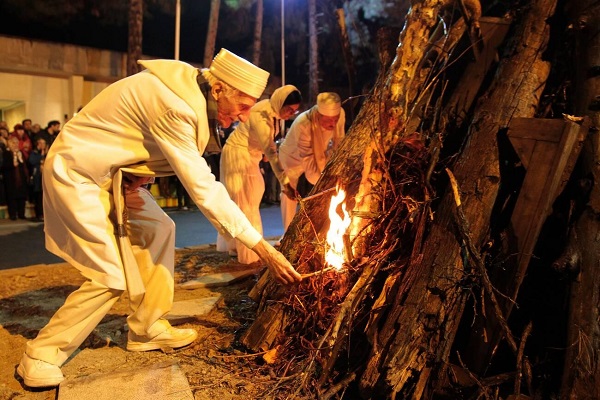
Zoroastrian places of worship are called Fire Temples. In them, an eternal flame is kept burning with sandalwood and frankincense. The first fire to be lit upon an altar is said to have been brought down from heaven by Zoroaster with a rod.
When the Parsis fled from Iran and settled in India, the fire was again brought down from heaven by lightning to create the sacred symbol of Ahura Mazda. The fire altar where that historic fire is still burning is an important pilgrimage site for the Parsis. The fire is such a sacred and holy symbol, so the fire temples are open only to Zoroastrians.
Social Practices
Today, Zoroastrians do not proselytise, and consequently, are born to the faith. If a Parsi woman marries outside the religion, her children cannot be Zoroastrians, but if a man marries outside, his children can become Zoroastrians, although his wife cannot. No doubt these restrictions are later aberrations not befitting the lofty ideals and teachings of the religion. 26
Festivals
Zoroastrianism has numerous festivals and holy days, all of which is bound to the Zoroastrian calendar. The Shahenshahi and Kadmi variants of the calendar do not intercalate leap years. Hence, the day of the Gregorian calendar year on which these days are celebrated shifts ahead with time. The third variant of the Zoroastrian calendar, known as either Fasli (in India) or Bastani (in Iran), intercalates according to Gregorian calendar rules. Thus, remains synchronous with the seasons. 27
Some of the famous festivals of the Zoroastrian community are as follows:
Nauruz and Mihrajan
The two great festivals of the Zoroastrians are the Nauruz (New Year) and the Feast of Mihrajan (Mithra), both of which last six days, the number perhaps being based on the six gahanbars. The first day of the New Year was called Nauruz-i Amma ('of the people') or Kucak ('little'), and the sixth was Nanruz-i Hasa ('noble') or Buzurg ('great'). The general scheme of celebration, according to Al-Biruni, was as follows:
“During these five days, it was the custom of the Kisras (Persian kings) that the king opened the Nauruz and then proclaimed to all that he would hold a session for them, and bestow benefits upon them. On the second day, the session was for men of high rank, and for the members of the great families. On the third day, the session was for his warriors, and for the highest Maubadhs (priests). On the fourth day, it was for his family, his relations and domestics. Moreover, on the fifth day it was for his children and clients, When the sixth day came, and he had done justice to all of them, he celebrated Nauruz for himself and conversed only with his special friends and those who were admitted into his privacy. For various legends connected with Nauruz, for the modern usages, for the particular importance of the concluding day and the legends connected with it.” 28
The second great festival was Mihrajan, the celebration of which, according to the ideal Avesta calendar, should begin 7th Sept. The near approach of Mihrajan to Nauruz in honour is well illustrated by a saying of Salman al-Farisi, cited by Al-Biruni:
“At Persian times, we used to say that God has created an ornament for His slaves, of rubies on Nauruz, of emeralds on Mihrajan. Therefore, these two days excel all other days in the same way as these two jewels excel all other jewels.” 29
This festival, like that of Nauruz, lasted six days. The first being Mihrajan-i Amma and the last Mihrajan-i Hasa. While, again, like Nauruz, the celebration was at one period spread over thirty days. The first five being, according to Al-Biruni, 'feast days for the princes, the second for the nobility, the third for the servants of the princes, the fourth for their clients, the fifth of the people, and the sixth for the herdsmen.' Thus, instead of each of the six gahanbars being represented by only one day of the festival, it was at one time honoured both at Nauruz and at Mihrajan by a period of five days.
The notable parallelism between Nauruz and Miharajan finds its very simple explanation in the fact that both were New Year festivals.
Frawardigan
This Frawardigan Jashan occurs on ruz Frawardin, the 19th day of Adar, the 9th month. In that day, a number of Parsis go to the Hill, where the Towers are built, contemporary pieces of sandalwood to be burnt in the sacred fire there and say their prayers. The priests recite the Afrinagan prayers. This is a day for the remembrance of the memory of all the dead. This day is important in connection with the dead in another way. When a person dies in a way as would not enable his relations to know the date of the Parsi month on which he died, then the ruz Frawardin, i.e., the 19th of the month is taken to be the date of his death. When even the month is not known, then the 9th month, the Adar, is considered to be the month. For example, suppose a man goes on a voyage and his boat sinks, and he is lost, and his relatives do not know the date on which the ship or boat was sunk, and he died. Then, for the observance of the day and the performance of the obsequies, they assume Frawardin the 19th day of the month to be the date of the month of his death. Suppose even the month of his death is not known; then they assume Adar, the 9th month, to be the month of his death. So, in such cases, they take the 19th of the 9th month to be the anniversaries of the deaths of persons whose date and month of death are not known. The reason why the month of Adar and not any other month, was assumed to be the month of mortality. It is said to be this that the injunction was made at a time, when, owing to the fact of an intercalary month being added in turn at the end of every 120 years, Adar was considered to be the last month of the year. In the case of persons dying on one of the five Gatha days, i.e., the intercalary days at the end of the year, there being no corresponding day for that day in the subsequent months. The day Frawardin is taken to be the day of his month, and the monthly religious ceremonies are enjoined to be performed on that day every month. 30
Pateti
This is a day of introspection and originally occurred on the last day (or on the last five days) of the calendar year. For reasons related to single day occasions being observed over six days, (the last day of) Pateti came to fall on (the first day of) the New Year's Day celebrations, and in India (Shahenshahi/Kadmi calendars) came to be "celebrated" on New Year's Day itself. Although the name has been retained, Pateti is no longer a day of introspection.
Adargan
It is celebrated on the 9th day Adar of the 9th month Adar. It is a festival in honour of the Yazata presiding over Fire. Hundreds of persons go to the Fire temples and recite Atash Niyayesh in honour of Adar, the Yazata that presides over Fire.
Zartosht No-Diso
It is the death anniversary of Zarathushtra, which is celebrated on the 11th day (Khorshed) in the 10th month (Dae). In the seasonal calendar, Zoroaster's death anniversary falls on December 26.
Khordad Sal
It is the jubilation of the birth anniversary of Zoroaster. It falls on the 6th day ((K)hordad) of the 1st month (Farvardin). In the seasonal calendar, Zoroaster's birth anniversary falls on March 26.
Six irregularly-spaced seasonal festivals, called gahanbars (meaning "proper season"), are celebrated during the liturgical year. The six festivals are additionally associated with the six "primordial creations" of Ahura Mazda, otherwise known as the Amesha Spentas, and through them with aspects of creation (the sky, the waters, the earth, plant life, animal life and humankind). Due to the peculiarities of the Shahenshahi and Kadmi variants of the Zoroastrian calendar, which do not intercalate and are therefore no longer synchronised with the seasons, the seasonal festivals are celebrated many months in advance. The six festivals are:
- Maidyozarem Gahanbar (literally: 'mid-greening'), originally celebrated as a mid-spring festival.
- Maidyoshahem Gahanbar ('midsummer'), originally celebrated on the summer solstice.
- Paitishahem Gahanbar ('bringing in the corn'), formerly celebrated as a harvest festival.
- Ayathrem Gahanbar ('bringing home (the herds)'), originally celebrated at the end of autumn.
- Maidyarem Gahanbar ('mid-year'), formerly celebrated on the winter solstice.
- Hamaspathmaidyem Gahanbar (for which there is no accepted literal meaning), celebrating humanity.
This gagambar is not a seasonal festival in the technical sense, but rather commemorates the souls of the dead at the end of the liturgical year. It is better known as frawardigan.
In the present-day, each of these festivals is celebrated over five days, except Hamaspathmaidyem Gahambar which is held over ten days. 31
Parsi sects and movements
Zoroastrianism also had many sects similar to the older religion, but after its downfall, the sects were also finished. According to Phiroz Nasarvanji Tavaria, there were at least 12 sects of this religion which were flourishing in Iran. He added a note in “A Manual of Khshnoom" which is a proof of it. He says:
“Our Master informed that before or shortly after, the fall of the Zoroastrian empire twelve different sects were known to have been formed who followed the Zoroastrian Faith to a greater or lesser extent, and among these, the Saheb-Dilan followed the Zoroastrian religion in its pristine purity. The Chaechast Sires who comprise the most advanced souls and who are on, a plane higher even than the Saheb Dilan, stand quite apart. Our Master used to say that this Chaechast sect went into seclusion some two hundred years before the fall of the Zoroastrian Empire.” 32
The sects to this day, have no major conflict in the beliefs. Their worshipping methods, temples and traditions are very alike. Minor disputes may be found. Many sects belong from India, and the sect Nezaan present their explanation of the Zoroastrianism with a little innovation and new aspect. Modern Zoroastrians disagree on whether it is permissible for outsiders to enter their religion. Now scattered in small minority communities in Persia, India, Europe, and North America and without a religious hierarchy, the Zoroastrians are governed by councils and high priests whose authority is only local. Even within a community, an individual may choose not to accept the ruling of the council or high priest. Zoroastrian communities and individuals thus have differing views on conversion. They tend to cluster around two general tendencies, reformist and traditionalist, but even within these groups, the variation is considerable. Reformist liberals urge acceptance of any individual who chooses his or her free will to practice Zoroastrianism. They distinguish between “acceptance,” which implies complete free will, and conversion and proselytism, which carry connotations of coercion or pressure. Nevertheless, there are those who believe in the missionary nature of Zoroastrianism and go so far as to encourage active proselytism. On the traditionalist side, some moderates permit the acceptance of spouses and the offspring of mixed marriages, but the strict constructionists refuse to accept as coreligionists even Zoroastrians who marry outside the faith and consider children born of such unions illegitimate. This controversy has become exacerbated in this century, as the scattered Zoroastrian communities are shrinking and experiencing increasing intermarriage. Opponents of conversion argue that, precisely because the community is so fragile, the acceptance of converts will dilute the ethnic strength of the religion and lead to its complete annihilation. The issue is of practical importance, since it affects admission to fire temples and “towers of silence,” as well as the legal privileges attached to membership in the community. 33
Demography
Zoroastrian communities comprise two main groups of people: those of South Asian Zoroastrian background known as Parsis (or Parsees), and those of the Central Asian background. Small Zoroastrian communities are set up all over the globe, with a continuing concentration in Western India, Central Iran, and Southern Pakistan. Zoroastrians of the diaspora are primarily located in Great Britain and the former British dependencies, notably Canada and Australia, as considerably as in the American land of California where they constitute part of the Iranian American community.
In South Asia
India is considered to be home to the largest Zoroastrian population in the world. When the Islamic armies, under the first Caliphs, invaded Persia, those locals who were unwilling to convert to Islam sought refuge, first in the mountains of Northern Iran, then the regions of Yazd and its surrounding villages. Subsequently, in the ninth century CE, a group sought refuge in the western coastal area of India, and also spread to other parts of the globe. Following the fall of the Sassanid Empire in 651 CE, many Zoroastrians migrated. Among them were several groups who ventured to Gujarat on the western shores of the Indian subcontinent, where they finally settled. The descendants of those refugees are today known as the Parsis. The year of arrival on the subcontinent cannot be precisely established, and Parsi legend and tradition assign various dates for the event.
In the Indian census of 2001, the Parsis numbered 69,601, representing about 0.006% of the total population of India, with a concentration in and close to the urban centre of Mumbai. Due to a low birth rate and high rate of emigration, demographic trends project that by 2020 the Parsis will number only about 23,000 or 0.002% of the total population of India. The Parsis would then cease to be called a community and will be labelled a "tribe". By 2008, the birth-to-death ratio was 1: 5; 200 births per year to 1,000 deaths. 34 In Pakistan, they number fewer than 1,700 mostly living in Karachi.
Iran, Iraq and Central Asia
Iran's figures of Zoroastrians have ranged widely; the last census (1974) before the revolution of 1979 revealed 21,400 Zoroastrians. Some 10,000 adherents remain in the Central Asian regions that were once considered the traditional stronghold of Zoroastrianism, i.e., Bactria (see also Balkh), which is in Northern Afghanistan; Sogdiana; Margiana; and other areas close to Zoroaster's homeland. In Iran, immigration, out-marriage and low birth rates are likewise leading to a decline in the Zoroastrian population. Zoroastrian groups in Iran say their number is approximately 60,000. According to the Iranian census data from 2011, the number of Zoroastrians in Iran was 25,271. 35
Communities exist in Tehran, as well as in Yazd, Kerman and Kermanshah, where many still speak an Iranian language distinct from the usual Persian. They call their language Dari (not to be confused with the Dari of Afghanistan). Their language is also called Gavri or Behdini, literally "of the Good Religion". Sometimes their language is named after the cities in which it is spoken, such as Yazdi or Kermani. Iranian Zoroastrians were historically called Gabrs, originally without a pejorative connotation, but in the present-day derogatorily applied to all non-Muslims.
More recently the Zoroastrian faith has gained strength among the Kurds in Iraq, claiming up to 100,000 adherents as of 2015. Zoroastrians currently seek official status for their religion in Iraqi Kurdistan. 36
Western world
North America is thought to be home to 18,000–25,000 Zoroastrians of both South Asian and Iranian background. A further 3,500 live in Australia (mainly in Sydney). In recent years, the United States has become a significant destination of Zoroastrian populations, holding the second largest population of Zoroastrians after India.
In upcoming pages we are proceeding towards the prophecies found in Zoroastrian literature about the Holy Prophet ﷺ and will see what is found in Zoroastrianism about him.
- 1 Theodore H. Robinson (1926), A Short Comparative History of Religions, Gerald Duckworth & Co. Ltd., London, U.K, Pg. 107.
- 2 Joseph Gaer (1958), The Wisdom of The Living Religions, Skeffington, London, U.K, Pg. 242.
- 3 James Hasting (Editor) (1912), Zoroaster, Encyclopedia of Religion and Ethics, T.&. T. Clark, New York. USA, Vol. 12, Pg. 862.
- 4 Vohu Manah is the Avestan language term for a Zoroastrian concept, generally translated as "Good Purpose", "Good Mind", or "Good Thought", referring to the good moral state of mind that enables an individual to accomplish his duties.
- 5 Amesha Spenta is an Avestan language term for a class of divine entities in Zoroastrianism and literally means "Immortal (which is) holy" (Mary Boyce (1983), "Aməsa Spənta", Encyclopaedia Iranica, 1, Routledge & Kegan Paul, New York, USA, Pg. 933–936.)
- 6 James Hasting (Editor) (1912), Zoroaster, Encyclopedia of Religion and Ethics, T.&. T. Clark, New York, USA, Vol. 12, Pg. 864.
- 7 Simon Blackburn (1994), "Philosophy", The Oxford Dictionary of Philosophy, Oxford University Press, Oxford, U.K, Pg. 405.
- 8 August Gladisch (1859), Herakleitos Und Zoroaster: Eine Historische Untersuchung, J. C. Hinrichs, Leipzig, Germany, Pg. IV.
- 9 Simon Blackburn (2005), The Oxford dictionary of philosophy, Oxford University Press, Oxford, U.K, Pg. 409.
- 10 West Litchfield Martin (2010), The Hymns of Zoroaster: A New Translation of the Most Ancient Sacred Texts of Iran, I. B. Tauris, London, U.K, Pg. 31.
- 11 Mary Boyce (1996) (1975), A History of Zoroastrianism: The Early Period, Brill, Vol. 1, Pg. 188-192.
- 12 James Hasting (Editor) (1912), Texts on Zoroastrian, Encyclopedia of Religion and Ethics, T. & T. Clark, New York, USA, Vol. 2, Pg. 266-268.
- 13 James Hasting (Editor) (1912), Texts on Zoroastrian, Encyclopedia of Religion and Ethics, T. & T. Clark, New York, USA, Vol. 8, Pg. 104.
- 14 According to Zoroastrianism to understand the profound significance and meaning of this term, we need to only consider what takes place in the thought of the poet: it is where all of the oral poet’s knowledge about the cosmos and the ritual is stored. Thus, the poet sacrificer’s “good thought” is the prerequisite for a good ritual, including good songs of praise, as in 1.30.1 “the praises and sacrificial (actions/utterances) of (my) good thought.” Most importantly, his thought/mind is necessarily where and that by which the oral poet composes his poems.
- 15 The two worlds are sometimes called the “spiritual and material” worlds, but these terms are relatively modern, have many different and partly very misleading implications.
- 16 In eastern Iran, the name continued to be associated with the sun and even came to mean “sun” after foreign religions had dethroned the Zoroastrian supreme deity: in Buddhist Khotan urmaysde means “sun, ” and so does Choresmian rmazd and modern Sanglechi remozd in the Muslim period.
- 17 Prods Oktor Skjaervo (2008), Introduction to Zoroastrianism, Cambridge University Press, Cambridge, UK, Pg. 12-22.
- 18 Dr. Bhadha Hoshang: http://tenets.zoroastrianism.com/topi33.html: Retrieved 23-12-2016.
- 19 This term, applied originally to solid offerings, was later applied to milk.
- 20 James Hasting (Editor) (1912), Zoroaster, Encyclopedia of Religion and Ethics, T.&. T. Clark, New York, USA, Vol. 12, Pg. 865.
- 21 Encyclopedia Iranica (Online Version): http://www.iranicaonline.org/articles/corpse-disposal-of-in-zoroastrianism: Retrieved: 10-02-18
- 22 It appears from the customs of several ancient nations that the dog played a prominent part in the funeral ceremonies of these nations like among the ancient Romans, Lares of the departed virtuous, were represented in pictures with a dog tied to their legs. This was intended to show, that as the dogs watched faithfully at the door of their masters, so the Lares watched the interests of the family to which they belonged.
- 23 The Gahs are the five different periods of the day. The first Gah, Hawan, begins with the dawn of the day and ends at twelve noon or midday. The second, Rapithwin, runs from twelve noon to three o’clock in the afternoon. The third, Uzerin, begins at three and continues until it is dark. The fourth, Aiwisruthrem, commences from when it is dark, and lasts upto midnight. The fifth Gah Ushahin, commences from midnight, and lasts upto the dawn of the day.
- 24 Jivanji Jamshedji Modi (1937), The Religious Ceremonies and Customs of the Parsees, Behranji Mansion, Bombay, India, Pg. 48-49.
- 25 The Tower of Silence wherein the dead bodies are exposed to the sun and to the flesh-eating birds, is generally built on the top of a hill or on an elevated ground. On such an elevated place, an isolated spot, away from human dwellings, is chosen for the Tower. Its construction all along is just in accord with the view held in the performance of the ceremonies for the disposal of the dead, viz., the sanitary view, which enjoins that, while disposing of the dead body with all respect due to the deceased, no injury or harm should be done to the living.
- 26 Theosophical Society in America: https://www.theosophical.org/publications/quest-magazine/42-publications/questm%20agazine/1231-zoroastrianism-history-beliefs-and-practices: Retrieved 23-12-2016.
- 27 Parsi Khabar: https://parsikhabar.net/culture/the-difference-between-shenshai-kadmi-and-fasli-zoroastrian-alenda r/8355/: Retrieved 23-12-2016.
- 28 Al-Biruni, quoted from James Hasting (Editor) (1912), Festivals and Fasts (Iranian), Encyclopedia of Religion and Ethics, T. & T. Clark, New York, USA, Vol. 5, Pg. 872.
- 29 Ibid
- 30 Jivanji Jamshedji Modi (1937), The Religious Ceremonies and Customs of the Parsees, Behranji Mansion, Bombay, India, Pg. 359-360.
- 31 Mary Boyce (2000), "Gahanbar", Encyclopedia Iranica, Vol. X, f3, Routledge & Kegan, Paul, New York, USA, Pg. 254–256.
- 32 Phiroz Nasarvanji Tavaria (Publishing Date: not given), A Manual Of "Khshnoom" The Zoroastrian Occult Knowledge, Published by: Mr. Sohrab Phiroze Masani (President, Parsee Vegetarian & Temperance Society) and Mr. Hormusji Jeejeebhoy Suntoke (President, Zoroastrian Rahih Society), Pg. 64.
- 33 Encyclopedia Iranica (Online Version): http://www.iranicaonline.org/articles/conversion-vii: Retrieved 23-12-2016.
- 34 The Independent: http://www.independent.co.uk/news/world/asia/doomed-by-faith-856095.html: Retrieved 23-12-2016.
- 35 Egypt Indepedent: http://www.egyptindependent.com/news/census-iran-young-urbanised-and-educated: Retrieved 23-12-2016.
- 36 Al-Monitar-The pulse of Middle East: http://www.al-monitor.com/pulse/originals/2016/02/iraq-kurdistan-religious-minorities-zoroastrianism.htm: Retrieved 23-12-2016.
Hamdani, Mufti Shah Rafi Uddin & Khan, Dr. (Mufti) Imran. (2018), Zoroastrianism – Faith, Sacred Texts and Ritual Practices, Encyclopedia of Muhammad ﷺ, Seerat Research Center, Karachi, Pakistan, Vol. 1, Pg. 715-738.
https://muhammadencyclopedia.com/article/en/zoroastrianism-faith-sacred-texts-and-ritual-practices