
Polytheism and the Genesis of Atheism: A Comparative Study of Religious Disenchantment
Published on: 13-Mar-2026This article examines how polytheistic religions—characterized by multiplicity of deities, anthropomorphic myth, and ritual pluralism—generated internal critiques that opened pathways to skepticism, naturalism, and, in some cases, explicit atheism. It proposes a comparative framework of four mechanisms by which polytheism seeded doubt: Multiplicity – rational contradiction, Anthropomorphism – ridicule and moral critique, Cultic plurality – moral relativism and conventionalism, and Ritual disenchantment – naturalistic explanation. Drawing on case studies from the Greek–Roman world (Xenophanes, the Sophists, Epicurus/Lucretius), South Asia (Carvaka materialism and sramana movements), and China (Confucian moral rationalism, Wang Chong’s naturalism, Neo-Confucian li/qi metaphysics, Legalist statecraft), the study shows how elite intellectual cultures increasingly reinterpreted or sidelined gods while popular polytheism persisted. It further situates the rise of early modern disbelief within post-monotheistic Europe, noting how the Renaissance and, especially, the Age of Enlightenment transformed scattered ancient skepticism into a widely discussed stance. From a theistic—and particularly Islamic—perspective, the decline of polytheism may be understood as an intellectual and moral transition that ultimately finds coherence in tawhid, the principle of Divine Oneness. Islam, in this sense, is presented not as a mere reaction to disbelief but as its transcendence—offering a unified metaphysical and ethical framework where earlier systems struggled for consistency. The article reframes atheism as neither purely modern nor solely post-Christian, but as a recurring outcome when religious worldviews fail internal tests of logic, morality, and explanatory power.
Polytheism
Polytheism can be understood as a religious worldview rooted in three interrelated elements. First, it involves the deification of natural phenomena—sky, earth, sun, moon, seas, plants, animals, and even ancestors, kings, and heroes are transformed into divine beings. Second, polytheism expresses itself through myth, where these deified forces are personified as gods and goddesses with distinct identities, stories, and ‘biographies.’ Myths provide meaning to the cosmos and give coherence to religious cults and practices. Third, polytheism includes the deification of material objects—whether natural items like stones and trees or human-made idols and images—which are treated as vessels or symbols of divine presence. This often leads to idol worship, though such material veneration can also slide into fetishism, which is not always an essential part of polytheism. 1 Together, these elements show how polytheism integrates nature, myth, and objects into a comprehensive system of belief and worship.
Polytheism is the belief in multiple gods, often organized into a pantheon. In polytheistic systems, no single deity has absolute power; instead, different gods typically oversee different aspects of nature or human life. These gods are usually distinct individuals with personal names, stories, and domains of influence. 2 Beyond its structural elements, polytheism has undergone shifting evaluations in intellectual and religious history. While Christianity and Islam traditionally condemned it as paganism or heresy, European thinkers from the Renaissance through Romanticism began to revalue it, sometimes even as a positive orientation. Goethe, for instance, could call himself a polytheist in art, a pantheist in science, and a Christian in morals, while German Idealism spoke of a ‘polytheism of imagination and art’ as a counterbalance to monotheistic rigidity. In modern contexts, scholars highlight its adaptability and pluralism, where a ‘division of labor’ among gods integrates new deities and models coexistence without exclusivist claims. This flexibility has inspired the so-called ‘new polytheism’ in contemporary Western thought, where myth and multiplicity are reclaimed as resources for creativity, pluralism, and ecological consciousness, showing polytheism as a complex and enduring mode of relating to the divine. 3 However, polytheism, despite being reinterpreted in modern thought as imaginative and pluralistic, historically gave rise to social and moral problems. By dividing divine authority among many gods, it often created rivalry, confusion, and instability in communal life. Its reliance on myth and idol-worship encouraged superstition, exploitation by priestly classes, and legitimization of oppressive hierarchies. Rather than a glamorous system, polytheism represents a fragmented worldview that failed to provide the unity, justice, and ethical clarity found in monotheism.
Types of Polytheism
Polytheism exhibits remarkable diversity across cultures, representing different modes through which societies conceptualized divine power and order. This section identifies four major types—naturalistic, mythological or anthropomorphic, functional, and philosophical polytheism—to clarify both, the internal coherence and inherent tensions of the polytheistic worldview. These variations reveal how multiplicity in divine imagination often stimulated theological reflection, critique, and eventual movement toward monotheistic or skeptical interpretations.
Naturalistic Polytheism
In many early religions, gods personify natural forces or phenomena. For example, in ancient Greece Helios was the sun god, Poseidon ruled the sea, and Gaia embodied the earth. 4 Similarly, Vedic India had Agni (fire), Vayu (wind), etc. 5 The divine was seen in nature – every river, mountain, or storm might have its deity.
Mythological/Anthropomorphic Polytheism
Anthropomorphism is the human tendency to attribute human qualities—such as form, emotions, or intentions—to non-human objects or supernatural entities. Historically advantageous for survival, this inclination became embedded in religious imagination, where gods and spirits were often portrayed in human-like terms. 6 They have personal biographies full of drama – love affairs, quarrels, jealousy and vengeance. The Greek and Roman pantheons are prime examples: Zeus (Jupiter) was the king of the gods with a notorious temper and many romantic exploits; his wife Hera (Juno) was jealous and vengeful, and so on. These deities possess superhuman abilities, but their personalities often mirror human foibles. 7 Furthermore, in mythological polytheism, stories about the gods (myths) are central to worship and cultural identity.
Functional Polytheism
In many polytheistic cultures, each god has a specific function or area of patronage, and people direct prayers to whichever god is relevant to their needs. There are war gods, fertility goddesses, harvest gods, gods of healing, of commerce, of arts, and so forth. 8 For example, the Romans honored Mars for war, Venus for love, Ceres for agriculture, Janus for doorways and transitions, etc. 9 Thus, religion becomes somewhat compartmentalized as an individual performed particular rites to the appropriate deity for a given concern. This created ambiguity when divine roles overlap or conflict, reducing worship to appeasement rather than coherent moral guidance. Such tensions highlight polytheism’s inability to offer a unified framework of meaning or authority.
Philosophical or Abstract Polytheism
Some traditions maintain multiple gods on the surface, but with an underlying philosophical unity. In these systems, the many gods may be understood as manifestations, aspects, or emanations of a single ultimate reality. In Hindu thought, for example, the Devas are seen as expressions (vibhutis, vyuhas) of Brahman, the supreme reality. The Upanishads describe Brahman as the indescribable essence behind all diversity, and later Hinduism systematized this unity in doctrines such as Advaita Vedanta and the Trimurti. 10 In Greco-Roman antiquity, philosophers like Plato and the Stoics likewise spoke of a single divine principle (e.g. the Logos or the One), relegating the Olympian gods to a secondary, lesser status (such as personified natural forces or allegories). 11 While such philosophical reinterpretations of polytheism appear to approach monotheism, by dissolving the gods into allegories or subordinate forces they often undermine belief itself, creating a path toward skepticism. In practice, this trajectory risked collapsing into atheism rather than yielding a coherent monotheism.
In summary, polytheism broadly means belief in many gods, but it ranges from naive idol-worship of numerous local deities to sophisticated theologies where the many are expressions of the One. The weaknesses of polytheism that led to atheism were more apparent in some forms—such as mythological polytheism, with its quarrelling and immoral gods—than in others, such as abstract polytheism, which sought to resolve logical problems by positing unity behind multiplicity. This spectrum helps explain both its appeal and its vulnerability: on the one hand, polytheism seemingly tried to offer pragmatic access to divine powers for every aspect of life, however, its internal tensions—between multiplicity and unity—often pushed thought either toward monotheism or, when the gods were reduced to mere allegories, toward atheism.
Structural Weaknesses of Polytheism
Several inherent features of polytheistic religions made them vulnerable to criticism from within. Key among these were: the multiplicity of gods leading to logical contradictions, the anthropomorphic portrayal of gods making them easy targets of ridicule, and the moral and ritual relativism that arose from having many gods with different demands. These features undercut the intellectual credibility of polytheism and invited skeptical scrutiny.
Multiplicity and Contradiction
By definition, polytheism involves multiple divine wills and powers, which inevitably produces internal contradictions that a logical mind struggles to reconcile. When one god decrees X and another decrees Y, the believer is left with irreconcilable conflict. The notion of multiple gods claiming omnipotence or sovereignty collapses under scrutiny, since true omnipotence cannot be shared. If one deity is subordinate, then the other is not truly a god in the fullest sense. 12 Classical polytheistic myths illustrate this instability: in Greek mythology, the gods frequently quarrel and even wage wars among themselves 13—the Trojan War in the Iliad, for example, is heavily shaped by rivalries between Zeus, Athena and Hera, Aphrodite, and others. 14 Such narratives inspired philosophical critique, as many observed, that gods who fight, deceive, or behave unjustly cannot genuinely embody divinity or be worthy of worship.
Xenophanes of Colophon (6th century BCE) was one of the earliest thinkers to directly challenge the logical coherence of the Greek pantheon. He observed that people credited the gods with actions and decisions that often contradicted each other or violated any consistent standard of justice. He ridiculed the traditional tales of divine conflict. In one fragment, Xenophanes pointed out that Homer and Hesiod – the revered poets who recounted the deeds of the gods – had attributed to the gods ‘all things that are a shame and a disgrace among mortals, such as stealing and adulteries and deceiving of one another.’ 15
If the chief Olympians themselves lied, stole, and cheated each other, they could hardly be taken seriously as divine. Xenophanes argued that a true deity must be morally consistent and above such pettiness. He also highlighted the contradictions of polytheistic prayer and divination, since different gods often gave conflicting or misleading signs, rendering appeals to ‘the gods’ incoherent. 16
The plurality of traditional Greek gods posed serious difficulties for explaining the origin and governance of the cosmos. Pre-Socratic philosophers struggled with this problem, either by modifying mythological deities, subordinating them to new principles, or dismissing them in favor of more unified explanations of nature. Later thinkers, such as Plato and the Stoics, attempted to resolve this tension by reinterpreting divinity as a single cosmological principle (world-soul, intellect, or logos) rather than a collection of conflicting anthropomorphic powers. 17
Later, in Laws Book X, Plato contends that attributing quarrels, corruption, or bribery to the gods makes them indistinguishable from mortals and thereby strips them of genuine divinity. Since true gods must be rational, unified, and morally perfect, belief in corruptible gods is effectively a denial of real divinity, which pushed thinkers towards Atheism and Naturalism. 18
Anthropomorphism
Polytheistic gods were not only numerous but also intensely anthropomorphic, imagined in human form with exaggerated personalities. 19 While this made them relatable in myth, it also exposed their flaws and invited skepticism. 20 Xenophanes famously noted that cultures projected their own image onto the gods—Ethiopians imagined them as black and snub-nosed, Thracians as red-haired with blue eyes—and quipped that if horses could paint, they would draw horse-shaped gods. 21 Such critiques revealed the gods as cultural constructs rather than transcendent beings.
Their mental traits were equally human, marked by lust, jealousy, anger, and favoritism. This fueled satire: Aristophanes mocked the gods in comedies like The Birds and The Clouds, 22 while Roman writers such as Lucian ridiculed them as petty or powerless. 23 By depicting gods as capricious and foolish, ancient literature eroded their credibility and made skepticism more plausible. Xenophanes himself concluded that there must be one true God unlike mortals, 24 but his critique of anthropomorphism laid the foundation for later rejection of polytheism in favor of philosophy, naturalism, or monotheism.
In summary, anthropomorphism undermined the aura of divine mystery and perfection. The more Zeus looked like a temperamental king, or Aphrodite like a vain seductress, the less they seemed like gods. Philosophers like Xenophanes took this to heart, insisting that the true divine must be utterly unlike weak, passionate mortals – perhaps singular, unchanging, and purely rational. Others took the next step and wondered if the very idea of gods was just a cultural story, not reality. Thus, the anthropomorphic gods, once objects of faith, became targets of laughs and logical attacks, eroding religious credulity.
Moral and Ritual Relativism
A major weakness of polytheism was the absence of a single, absolute moral authority. Each deity had its own code and demands, often at odds with those of others, which produced moral relativism and confusion. Plato illustrated this in Euthyphro, where Socrates showed the incoherence of grounding morality in quarrelsome gods who did not agree on what was sacred. Socrates states:
Socrates: The same things, it seems, are both hated by the gods and loved, and so would be both despised and beloved by them?
Euthyphro: It seems so.
Socrates: And the same things would be both pious and impious, Euthyphro, according to this argument? 25
Furthermore, the lack of a unified divine lawgiver made morality appear as a matter of shifting convention rather than objective truth, a view echoed by Sophist thinkers who argued that ethics (nomos, custom) was human-made. This can be seen in the quote of Protagorus, an eminent sophist who states:
Man is the measure of all things. 26
This implies that truth (and by extension moral value) depends on human perception and convention, not divine decree. Critias, another famous sophist states:
...I believe, that a shrewd and clever-minded man invented for mortals a fear of the gods... 27
This quote portrays religion as a human invention, crafted to maintain social order. It presents morality as a pragmatic tool for regulating behavior rather than a divine command. In this view, ethical norms arise from social necessity, not transcendent truth.
Furthermore, the diversity of rituals further undermined confidence in polytheism. What pleased one god could offend another, 28 and outsiders often dismissed each other’s rites as absurd or cruel. Lucretius later denounced religion for driving men to commit evils in the name of sacrifice and ritual, urging a naturalistic explanation of the world as an escape from superstition. 29 Such critiques highlighted how ritual plurality could sow doubt about the validity of all worship.
Polytheism also encouraged the idea that the gods could be bribed through sacrifices and offerings. Piety became a transaction: people believed they could commit wrongdoing and then secure divine favor with costly gifts. Plato observed that worshippers 'persuade the gods to forgive injustice by sacrifices and prayers'. 30 Ovid stated that gods could be persuaded to provide the individual with benefits in exchange of sacrifices, 31 despite the injustices. Plato insisted that true divinity could not be corrupted, 32 yet in practice, the image of gods with varying character traits sustained the belief that some might be swayed, weakening any consistent moral framework.
Finally, the multiplicity of gods and cults led to relativism in belief itself. Across the Mediterranean, worshippers could turn to Olympian deities, local spirits, deified heroes, or imported cults. 33 By the Hellenistic and Roman eras, many educated people regarded this variety as cultural allegory or poetic symbolism rather than divine reality. 34 For the masses, such pluralism fostered tolerance, but for philosophers, it bred skepticism and the suspicion that the gods were human inventions. 35
Overall, polytheism’s fragmentation of moral and ritual authority made it hard to sustain the idea that divine law truly governed the world. Without a single divine moral compass, thoughtful individuals turned to philosophy, ethics, and law as human endeavors – effectively secularizing morality. And without a clear consensus on rites and gods, many concluded that religion was a matter of tradition, not truth, weakening the hold of faith and nudging some toward open unbelief.
The Path from Polytheism to Skepticism
Given the above weaknesses, it is not surprising that polytheistic cultures generated critical responses from within. A general path can be traced by which polytheism’s cracks led to outright skepticism or atheism:
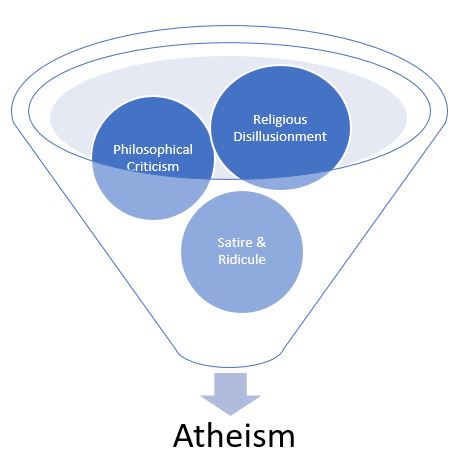
Figure. 1
Philosophical Criticism
Early philosophers in polytheistic societies did not always begin with outright denial of the gods. Instead, they reinterpreted, minimized, or explained them away, 36 gradually weakening their role until the gods became unnecessary. By the 5th century BCE in Greece, this intellectual process was already reshaping religious thought and edging toward atheism in substance, if not always in name. 37
Xenophanes stood out as a critic of the Homeric and Hesiodic deities. He mocked the idea that gods could quarrel, steal, or commit adultery, and observed that each people imagined gods in their own likeness. 38 In place of this anthropomorphism, he posited a single, supreme God—unchanging, all-seeing, and ruling by the thought of His mind. 39 Though not atheistic, Xenophanes’ vision effectively erased the pantheon and replaced it with a philosophical unity, radically different from popular religion.
Anaxagoras took the daring step of reinterpreting the heavens. He was the first to write that the Moon’s phases resulted from its natural, earth-like body reflecting the Sun’s light rather than from divine influence, 40 a claim that led to charges of impiety in Athens. 41 Still, his natural explanation could not be silenced, as later on, the celestial bodies were increasingly seen as physical objects, governed by nature rather than by divine personalities.Democritus, with his teacher Leucippus, went further still by developing atomic theory. All things, he argued, were composed of indivisible atoms moving through the void, leaving no room for divine intervention. Reports suggest he even reduced visions of gods to films of atoms striking human senses. 42 This profound materialism stripped away the need for divine causation and gave early atheism a theoretical foundation.
Prodicus of Keos offered a rational account of religion’s origins. He claimed that early humans first deified the natural elements that sustained life—sun, rivers, fruits—and later exalted the inventors of useful arts as gods. In this analysis, gods were not transcendent beings but projections of human gratitude and necessity. 43 By tracing divinity to human invention, Prodicus demystified religion and opened the way for skepticism.
The Sophists and Socratics carried the critique into public life. Diagoras of Melos became infamous as ‘the atheist’ for openly mocking rituals and rejecting the gods. 44 Critias, in the striking Sisyphus fragment, described religion as a deliberate fabrication: a story of an all-seeing deity invented to instill fear and curb wrongdoing. 45 Such ideas, whether dramatized in plays or debated in circles, amounted to a bold declaration that the gods were human constructs.
Epicurus and Lucretius brought these trends to their culmination. Epicurus maintained that the gods, if they exist, live in serene detachment, utterly unconcerned with human affairs. 46 Lucretius, in his ‘On the Nature of Things’, built on this vision with poetic force: nature is governed by atoms and void, not by divine caprice. 47 He condemned religion as a source of terror and cruelty, praising Epicurus as the liberator who crushed superstition beneath his feet. 4849 In all these cases, we see that rational explanations and critical theories grew out of a discontent with polytheistic tradition. Bit by bit, philosophers took functions away from the gods: first explaining day and night, then thunder and earthquakes, then life itself, in purely natural terms, or explaining that religion has psychological or social causes, not divine ones. Each step reduced the intellectual need for gods. By the time of the Roman Empire, a well-educated person could attribute practically every event either to nature or human agency, with the gods serving only a symbolic role. Thus, polytheism’s sphere contracted under the onslaught of philosophy, until for some, nothing of the old religion remained credible – an atheistic worldview had quietly taken root.
Satire and Ridicule
Intellectual critiques were powerful, but humor and irreverence in popular culture often signaled an even deeper shift in religious attitudes. In several ancient polytheistic societies—particularly in late classical Greece and Rome—the gods, once feared and venerated, increasingly appeared as comic, fallible, or absurd figures in literature and performance. 50
In classical Athens, comic playwright Aristophanes openly lampooned the gods on stage. 51 In ‘The Clouds’, his parody of Socrates dismisses Zeus as the cause of rain and instead swears by the ‘vortex.’ 52 In ‘The Birds’, he portrays birds building a city in the sky and demanding sacrifices from the Olympians, mocking the religious order itself. 53 These plays were performed at public festivals—and even won prizes—showing that Athenians not only tolerated but delighted in irreverence toward the gods. 54
Everyday wit also chipped away at reverence. The Cynic philosopher Diogenes of Sinope mocked religious customs with biting quips. He ridiculed people for praying for trivialities, arguing they already had the means to achieve them without divine help. In another anecdote, he remarked that sacrifices insulted the gods if they existed and wasted time if they did not. 55 This desacralization through ridicule reflected and reinforced a growing disillusionment with traditional mythic authority. 56 Thus, in ancient Greece, theatrical comedies, satirical epics, and anecdotal humor that mocked divine misbehavior functioned not merely as entertainment but as cultural indicators of a society in which religious belief was being psychologically and morally renegotiated. Humor, in this context, became a safe vehicle for dangerous ideas: in the case of polytheism, jokes about the gods were a symptom of a creeping realization that perhaps the gods were just characters in stories, not masters of reality. Once that realization set in, the road to overt atheism was open. In essence, the old gods had become an open joke, and those who still clung to literal belief were increasingly seen as ignorant or simple-minded; thus, polytheism’s decline was hastened by the laughter of its erstwhile adherents.
Religious Disillusionment
Many people abandoned belief in the gods not only through philosophical critique or satire but through emotional and practical disillusionment. When religion failed to offer meaning, moral authority, or genuine spiritual depth—when it became hollow ritual or a tool of exploitation—thoughtful individuals turned away.
In Greece, a similar skepticism targeted oracles and cults. The oracle of Delphi grew infamous for vague or biased answers, undermining trust. 57 Euhemerus (c. 300 BCE) suggested that the gods were simply deified kings, 58 a tale that resonated with widespread cynicism. This climate bred quiet disbelief, even as rituals persisted.
Some thinkers went further, exposing religion as deliberate invention. The Sisyphus fragment attributed to Critias describes a lawgiver fabricating the idea of an all-seeing god to frighten people into obedience. 59 Religion, he claimed, was ‘a false tale’ designed for control—a view rooted in political realism and moral disgust at the hypocrisy of cults. Similar disillusionment shaped satire and skepticism in Rome, where critics observed that the gods served more as tools of power than genuine sources of justice.
In all these cases – whether the fiery rejection of Carvaka, the cynical pronouncements of Critias, or the gentle sidelining of spirits by Confucians – the root cause is dissatisfaction with the existing religion’s credibility and value. Polytheism, when it failed to provide moral guidance or believable cosmology, lost the confidence of its sharpest minds. Those minds then sought truth elsewhere: in direct observation, in logical principles, or in ethical humanism. Thus, was atheism (or at least non-theism) born as a solution to religious disappointment. When the gods no longer seemed to hear or care, some people stopped believing in them and started believing in human reason instead.
Other Historical Case Studies
To ground the analysis, let’s briefly survey two other cultural areas where polytheism’s encounter with skepticism played out in notable ways:
- Indian Antiquity: Polytheism to materialist atheism (e.g. the Carvaka school) in South Asia.
- Chinese Antiquity: Polytheism to Confucian secular rationalism in East Asia.
Each case will highlight how the general patterns we discussed took shape under different circumstances.
Indian Polytheism – Carvaka Materialism
In ancient India, the story of skepticism unfolded with unique features. The early Vedic religion (1500–1200 BCE) was polytheistic, 60 praising gods such as Indra, Agni, and Varuna. 61 Over time, a hereditary priesthood consolidated power around complex sacrifices, making ritual central to religious life. Between the 8th and 4th century BCE, Indian society entered a period of ferment often called the Axial Age, when alternative movements challenged Vedic orthodoxy. Among them were the Sramana traditions—Buddhism and Jainism—which downplayed or ignored gods, 62 and the Carvaka (Lokayata) school, which was openly materialist and somewhat atheistic. The Carvakas rejected the authority of the Vedas, denied gods, karma, and rebirth, and accepted only direct perception (pratyaksa) as valid knowledge. They taught that consciousness arises from matter, just as the power of intoxication emerges from mixed ingredients, and that death is final. 63 Their maxim states:
“While life is yours, live joyously;
None can escape Death’s searching eye:
When once this frame of ours they burn,
How shall it e’er again return?” 64
This summed up a life-affirming materialism. Far from promoting indulgence, this view encouraged people to focus on this world rather than illusory promises of the next.
The Carvaka texts—preserved mostly through the writings of their opponents—contain incisive critiques of ritualism and priestly authority. They derided sacrificial rites, mocked ascetic practices, and accused Brahmin priests of fabricating the Vedas for personal gain. One fragment describes the Vedas as the ‘buffoon’s work’ of deceitful priests, 65 while another satirically observes that if animals slain in sacrifices are believed to attain heaven, the same logic would compel one to sacrifice one’s own father to secure his heavenly reward. 66 Such sarcasm reflects profound disillusionment with the polytheistic religion of the time. Furthermore, the Carvakas represent one of the earliest sustained traditions of atheism, born from rational critique and moral disillusionment with polytheism, and their challenge helped shape the trajectory of Indian religious thought.
Other teachers, like Ajita Kesakambalin, voiced similar views, denying soul and afterlife and affirming that humans return to the elements at death. 67 Together, these voices formed a skeptical counterculture within Indian thought.
Unlike Athens, where impiety could mean death, in India the Carvakas were engaged largely through philosophical debate. Their influence is evident from the fact that nearly every later Hindu system includes detailed refutations of materialism. 68 In response, Hindu traditions adapted: animal sacrifice diminished, and new theistic currents developed. These reforms helped Hinduism survive and renew itself, unlike the Olympian religion of Greece, which faded under philosophical critique and Christianity’s rise.
By the medieval era, Carvaka as a formal school had vanished, but its imprint endured. 69 However, elements of empiricism and skepticism resurfaced in other systems, like the Nyaya’s emphasis on perception, the essentially non-theistic Samkhya philosophy. 70 Thus, although the Carvaka tradition disappeared as an organized philosophical school by the medieval period, its intellectual spirit survived—diffused into the broader current of Indian thought. Its core impulses toward empirical reasoning, sensory verification, and skepticism toward metaphysical authority subtly re-emerged within systems that outwardly upheld orthodoxy, such as Nyaya’s rigorous epistemology and Samkhya’s non-theistic naturalism which alluded towards atheism.
In conclusion, the Indian case shows that polytheism’s extravagances and perceived oppressiveness (caste, ritual fees, etc.) provoked a home-grown atheistic response. The existence of explicit atheists in ancient India contradicts any notion that atheism is a purely modern or Western phenomenon. The loosening of ‘traditional bonds’ created space for radical ideas, including the denial of the gods. Carvaka represents the endpoint of that trajectory: from many gods, to doubt about rituals, to denial of anything beyond matter. It’s a vivid example of polytheism preparing the soil for atheism.
Chinese Folk Polytheism – Confucian Rationalism
Early Chinese religion revolved around ancestor worship, animism, and polytheism. People honored Heaven (Tian) as a high principle and sacrificed to countless local deities—river gods, mountain gods, and the spirits of departed ancestors. 71 It was a highly ritualized system where sacrifices were meant to keep harmony with cosmic and ancestral powers.
During the Zhou Dynasty, especially in the Spring and Autumn and Warring States periods, 72 intellectual and social upheaval gave rise to China’s classical philosophies: Confucianism, Daoism, Mohism, and Legalism. These schools focused less on worship and more on ethics, order, and cosmology. 73 Confucius (551–479 BCE) set the pattern: he encouraged rituals (li) as a way to cultivate respect and social harmony, 74 but avoided speculation about spirits or the afterlife. 75 In the Analects, he says, he does not speak of ‘strange or spiritual matters,’ and when asked about death, he replied that one must understand life first. 76 He sometimes invoked Heaven (Tian), but more as a principle of fate or moral order than a personal god. 77 This practical agnosticism meant that for the educated, moral conduct and human relationships mattered more than divine worship.
This outlook became the ideology of the scholar-official class. Officials continued to perform rituals to Heaven, Earth, and local gods as part of their state duties, but their own studies were centered on the Confucian Classics, not myths about gods. 78 Over time, a dual system developed. Ordinary people kept vibrant folk worship of deities like Mazu, or dragon kings, while the elite interpreted religion in symbolic or ethical terms.
By the imperial period, skeptical voices grew more explicit. Wang Chong (1st c. CE), in Lunheng, rejected superstitions, explaining thunder and eclipses as natural phenomena rather than signs of divine anger, and treating ghost stories as illusions or exaggerations. 79 Neo-Confucian scholars like Zhu Xi (12th c.) explained spirits as the natural interplay of yin and yang energies and cosmic principles. 80 Legalist thinkers such as Han Fei (3rd c. BCE) even advised rulers that good governance depended on law and punishment, not on trusting in spirits. 81 Across these traditions, Heaven was kept as an abstract principle, but the multitude of folk gods was reduced to metaphor or ignored altogether. The result was a long-lasting secular intellectual tradition. Folk polytheism remained lively at the popular level, but among the literati skepticism was mainstream. This created a stable, pragmatic agnosticism.
In summary, Chinese polytheism gradually gave way to an ethical rationalism without explicit rebellion. Confucian scholars respected the role of religion in promoting morality and order, but they themselves explained the world in non-theistic terms. One could say China had many ‘closet atheists’ or at least apa-theists (those who just did not care about gods) for millennia. When Buddhism arrived with its pantheon of Bodhisattvas and its promise of salvation, many Chinese took to it devotionally – showing the populace’s enduring need for worship – but even Buddhism in China was often signified to focus on moral teachings and meditation, not on creator deities. The overarching trend was the relegation of polytheistic belief to the private, popular sphere, while public philosophy went its way without the gods. Thus, Chinese civilization demonstrates another path from polytheism to effectively atheistic philosophy – a slow transformation rather than open confrontation.
Mechanisms of Transition from Polytheism to Atheism
From the preceding discussions, several mechanisms show how the internal weaknesses of polytheism helped foster skepticism and eventually atheism:
- Multiplicity → Rational Doubt: The existence of many gods with overlapping or conflicting powers invited rational doubt. Contradictory myths and incoherent cosmologies led thinkers to seek unity — some found it in one transcendent God, others in a godless, natural order governed by uniform laws.
- Anthropomorphism → Ridicule and Critique Portraying gods as humanlike made them vulnerable to satire and moral criticism. Philosophers such as Xenophanes exposed divine images as human projections, while dramatists like Aristophanes mocked divine folly, eroding awe and paving the way for disbelief.
- Plurality of Cults → Moral Relativism → Skepticism: The diversity of cults and local deities revealed the relativity of religion and morality. Observing that “each nation worships its own gods” led thinkers like the Sophists and Critias to conclude that religion was a social construct—a tool of control rather than divine truth.
- Disenchantment with Ritual → Naturalistic Explanations: When rituals failed or priests appeared corrupt, faith weakened and natural inquiry grew. Thinkers from Thucydides to Lucretius replaced divine causation with empirical observation, transforming fear of gods into trust in nature and reason.
To summarize, polytheism unwittingly contained the seeds of atheism in that its failures and limitations provoked people to imagine a world without gods. When gods were too numerous, too human, too morally ambivalent, and too ineffectual in practice, it was a short leap for some to say: maybe they were man-made. Each of the above mechanisms contributed to that leap. Not every skeptic went all the way to denying all gods – some became monotheists or deists, believing in a stripped-down single deity or impersonal principle. But the historical record is clear that some individuals in polytheistic milieus did take the final step to atheism (in belief if not always in public declaration). The journey often started with critiquing polytheism’s contradictions and ended with embracing a worldview that needed no gods at all.
In conclusion, it can be observed that polytheism provided the first cracks in the edifice of supernatural belief, but whether those cracks were filled by a new religious cement (monotheism, pantheism, etc.) or widened into a chasm of disbelief varied by time and place. The argument ‘polytheism to atheism’ is not a universal rule, but a historical pattern observed in several key instances.
From a theistic perspective however, it can be inferred that false gods logically led to no gods because if people were worshipping illusions, disillusionment was inevitable. Interestingly, early Christian and Muslim theologians made exactly that point: that pagan polytheism was so obviously flawed that it either needed to be supplanted by true religion or it would collapse into impiety. In that sense, religious scholars agree that polytheism was a preparatory stage that had to be transcended – though they of course advocate transcending it via monotheism rather than atheism. From a comprehensive historical and philosophical perspective, Islam represents the culmination of this long search—a restoration of pure monotheism (tawhid) in its most uncompromising and rational form. Islam affirms what earlier traditions groped toward: the oneness, transcendence, and coherence of the Divine. In this sense, the Islamic worldview can be seen not merely as a reaction to polytheism, but as its ultimate resolution—transforming humanity’s fragmented intuitions about the sacred into a unified, consistent, and intellectually defensible faith, while providing answers to their ultimate questions.
A neutral historical observer can see merit in this viewpoint: civilizations that moved from polytheism to ethical monotheism often underwent a kind of moral and intellectual revolution, providing a more solid basis for belief. Those that did not adopt a new faith sometimes saw a growth in secular philosophies that filled the void left by collapsing old beliefs.
- 1 Yehezkel Kaufmann (1951), The Bible and Mythological Polytheism, Journal of Biblical Literature, Society of Biblical Literature, Georgia, USA, Vol. 70, No. 3, Pg. 180.
- 2 Sarah Iles Johnston (Ed.) (2004), Religion of the Ancient World: A Guide, The Belknap Press of Harvard University Press, Massachusetts, USA, Pg. 17 & 24.
- 3 Kocku von Stuckrad (2007), The Brill Dictionary of Religion, Brill, Leiden, Netherlands, Vol. 3, Pg. 1466-1470.
- 4 Walter Burkert (1985), Greek Religion: Archaic and Classical (Translated by: John Raffan), Blackwell Publishing, Oxford, U.K., Pg. 136 & 175.
- 5 Gavin Flood (1996), An Introduction to Hinduism, Cambridge University Press, Cambridge, U.K., Pg. 45.
- 6 Bill Cooke (2006), Dictionary of Atheism, Skepticism & Humanism, Prometheus Books, New York, USA, Pg. 38.
- 7 W. K. C. Guthrie (1967), The Greeks and their Gods, Beacon Press, Boston, USA, Pg. 55-56.
- 8 Irene Polinskaya (2013), A Local History of Greek Polytheism: Gods, People, and the Land of Aigina, 800–400 BCE, Brill, Leiden, Netherlands, Pg. 103-104.
- 9 Encyclopedia Britannica (Online): https://www.britannica.com/topic/Roman-religion/Beliefs-practices-and-institutions: Retrieved: 12-02-2026
- 10 Jeffery D. Long & Et al. (Ed.) (2022), Hinduism and Tribal Religions, Springer, Dordrecht, The Netherlands, Pg. 996-998.
- 11 John Dillion (1996), The Middle Platonists: 80 B.C. to A. D. 220, Cornell University Press, New York, USA, Pg. 7.
- 12 Stanford Encyclopedia of Philosophy (Online): https://plato.stanford.edu/entries/monotheism/: Retrieved: 12-02-2026
- 13 Walter Burkert (1985), Greek Religion: Archaic and Classical (Translated by: John Raffan), Blackwell Publishing, Oxford, U.K., Pg. 121-122.
- 14 Thomas Galoppin & Et al. (Ed.) (2022), Naming and Mapping the Gods in the Ancient Mediterranean, Walter de Gruyter GmbH, Berlin, Germany, Vol. 1, Pg. 113-114.
- 15 A. A. Long (Ed.) (1999), Cambridge Companion to Early Greek Philosophy, Cambridge University Press, Cambridge, U.K., Pg. 210.
- 16 Ibid, Pg. 210-211.
- 17 Vilius Bartninkas (2023), Traditional and Cosmic Gods in Later Plato and the Early Academy, Cambridge University Press, Cambridge, U.K., Pg. 1-3.
- 18 Internet Encyclopedia of Philosophy (Online), https://iep.utm.edu/pla-laws/: Retrieved: 12-02-2026
- 19 W. K. C. Guthri (1967), The Greeks and their Gods, Beacon Press, Boston, USA, Pg. 55-56.
- 20 Edward L. Schoen (1990), Anthropomorphic Concepts of God, Religious Studies, Cambridge University Press, Cambridge, U.K., Vol. 26, Issue: 1, Pg. 123.
- 21 J. H. Lesher (Ed.) (1992), Xenophanes of Colophon: Fragments A Text and Translation with a Commentary, University of Toronto Press, Toronto, Canada, Pg. 96-97.
- 22 Michael Martin (2007), The Cambridge Companion to Atheism, Cambridge University Press, Cambridge, U.K., Pg. 14.
- 23 Stephen Bullivant & Michael Ruse (2021), The Cambridge History of Atheism, Cambridge University Press, Cambridge, U.K., Pg. 108.
- 24 J. H. Lesher (Ed.) (1992), Xenophanes of Colophon: Fragments A Text and Translation with a Commentary, University of Toronto Press, Toronto, Canada, Pg. 104-105.
- 25 Plato (2007), Euthyphro (Translated by Cathal Woods and Ryan Pack), Creative Commons, California, USA, Pg. 6.
- 26 Plato (1881), The Theaetetus (Translated by Benjamin Hall Kennedy), Cambridge at the University Press, Cambridge, U.K., Pg. XIII.
- 27 Charles H. Kahn (1997), Greek Religion and Philosophy in the Sisyphus Fragment, Phronesis: A Journal for Ancient Philosophy, Brill, Leiden, Netherlands, Vol. 42, No. 3, Pg. 247.
- 28 Atin Basuchoudhary, Mario Ferrero & Timothy Lubin (2020), The Political Economy of Polytheism: The Indian Versus the Greco-Roman Religions, Homo Oeconomicus, Springer Nature, Switzerland, Vol. 37, Pg. 22-23.
- 29 Lucretius (1948), Lucretius on the Nature of Things (Translated by Cyril Bailey), Oxford at the Clarendon Press, Oxford, U.K., Pg. 29-30.
- 30 Plato (2018), The Republic (Translated by Tom Griffith), Cambridge University Press, Cambridge, U.K., Pg. 44-46.
- 31 William Thynne (1833), A Translation of Ovid's Fasti into English Prose, J. D. Scott and Co. Printers, Dublin, Ireland, Pg. 17-18.
- 32 E. B. England (Ed.) (1922), The Laws of Plato, Manchester at the University Press, Manchester, U.K., Vol. 2, Pg. 29-30.
- 33 Marcus Tullius Cicero (1967), De Natura Deorum Academia (Translated by H. Rackham), Harvard University Press, London, U.K., Pg. 181-183.
- 34 Plutarch (1999), Moralia (Translated by Frank Cole Babbitt), Harvard University Press, London, U.K., Vol. 5, Pg. 117-119.
- 35 Jorg Rupke (2016), On Roman Religion: Lived Religion and the Individual in Ancient Rome, Cornell University Press, London, U.K., Pg. 1-2.
- 36 J. Tate (1929), Plato and Allegorical Interpretation, The Classical Quarterly, Cambridge University Press, Cambridge, U.K., Vol. 23, Issue: 3-4, Pg. 142.
- 37 A. A. Long (Ed.) (1999), Cambridge Companion to Early Greek Philosophy, Cambridge University Press, Cambridge, U.K., Pg. 15-16.
- 38 Ibid, Pg. 210.
- 39 J. H. Lesher (Ed.) (1992), Xenophanes of Colophon: Fragments A Text and Translation with a Commentary, University of Toronto Press, Toronto, Canada, Pg. 104-105.
- 40 Plutarch (1932), Lives: Pericles and Fabius Maximus; Nicias and Crassus (Translated by Bernadotte Perrin), William Heinemann Ltd., London, U.K., Vol. 3, Pg. 291.
- 41 Ibid, Pg. 93.
- 42 Stanford Encyclopedia of Philosophy (Online): https://plato.stanford.edu/entries/democritus/: Retrieved: 12-02-2026
- 43 Marcus Tullius Cicero (1967), De Natura Deorum Academia (Translated by: H. Rackham), Harvard University Press, London, U.K., Pg. 113-115.
- 44 Michael Martin (2007), The Cambridge Companion to Atheism, Cambridge University Press, Cambridge, U.K., Pg. 18.
- 45 Charles H. Kahn (1997), Greek Religion and Philosophy in the Sisyphus Fragment, Phronesis: A Journal for Ancient Philosophy, Brill, Leiden, Netherlands, Vol. 42, No. 3, Pg. 247.
- 46 Grant Campbell Pegler (2023), The Social and Political Implications of Expressing Atheistic Thought in Ancient Greece and the Early Roman Empire, and Why These Implications Changed Over Time: A Thesis Presented at Massey University, Auckland, New Zealand, Pg. 72.
- 47 Lucretius (1948), Lucretius on the Nature of Things (Translated by Cyril Bailey), Oxford at the Clarendon Press, Oxford, U.K., Pg. 60-61.
- 48 Ibid, Pg. 10.
- 49 Ibid. Pg. 16.
- 50 Inger N. I. Kuin (2023), Lucian’s Laughing Gods: Religion, Philosophy, and Popular Culture in the Roman East, University of Michigan Press, Michigan, USA, Pg. 2-3.
- 51 Sarah Miles (2011), Gods and Heroes in Comic Space. A Stretch of the Imagination?, Dionysus Ex Machina, G.B. Palumbo Editore & C. S.P.A, Palermo, Italy, Vol. 2, Pg. 109-110.
- 52 Alan H. Sommerstein (Ed.) (1982), The Comedies of Aristophanes: Clouds, Aris & Phillips Ltd., Wiltshire, U.K., Vol. 3, Pg. 47.
- 53 W. C. Green (Trans.) (1874), The Birds of Aristophanes, J. Hall & Sons, Cambridge, U.K., Pg. 20-21.
- 54 John Roberts (Ed.) (2007), The Oxford Dictionary of the Classical World, Oxford University Press, Oxford, U.K., Pg. 172.
- 55 Diogenes the Cynic (2012), Sayings and Anecdotes (Translated by Robin Hard), Oxford University Press, Oxford, U.K., Pg. 89.
- 56 Ronald Paulson (1967), The Fictions of Satire, The John Hopkins Press, Maryland, USA, Pg. 16-17.
- 57 Carolyn Dewald & Rosaria Vignolo Munson (Ed.) (2022), Herodotus: Histories, Cambridge University Press, Cambridge, U.K., Book 1, Pg. 244.
- 58 Nickolas P. Roubekas (2014), What is Euhemerism? A Brief History of Research and Some Persisting Questions, Bulletin for the Study of Religion, Equinox Publishing, Sheffield, U.K., Vol. 43, No. 2, Pg. 30.
- 59 Charles H. Kahn (1997), Greek Religion and Philosophy in the Sisyphus Fragment, Phronesis: A Journal for Ancient Philosophy, Brill, Leiden, Netherlands, Vol. 42, No. 3, Pg. 247.
- 60 Gavin Flood (1996), An Introduction to Hinduism, Cambridge University Press, Cambridge, U.K., Pg. 37.
- 61 Ibid. Pg. 61.
- 62 Johannes Bronkhorst (Ed.) (2007), Greater Magadha: Studies in the Culture of Early India, Brill, Leiden, Netherlands, Pg. 15-16.
- 63 Ibid., Pg. 151-153.
- 64 Madhava Acharya (1882), The Sarva-Darsana-Samgraha (Translated by E. B. Cowell & A. E. Gough), Trubner & Co., London, U.K., Pg. 2.
- 65 Ibid. Pg. 10-11.
- 66 Ramkrishna Bhattacharya (2011), Studies On The Carvaka/Lokayata, Anthem Press, London, U.K., Pg. 91.
- 67 F. Max Muller (Ed.) (1977), Dialogues of the Buddha (Translated from the Digha Nikaya by T. W. Rhys Davids), Redwood Burn Limited, Hampshire, U.K., Part 1, Pg. 73-74.
- 68 Debiprasad Chattopadhyaya (1992), Lokayata: A Study in Ancient Indian Materialism, People’s Publishing House, New Delhi, India, Pg. 12.
- 69 Johannes Bronkhorst (2016), Who were the Carvakas? Revista Guillermo de Ockham, Universidad de San Buenaventura Cali, Cali, Columbia, Vol. 14, No. 1, Pg. 8.
- 70 Sarvepalli Radhakrishnan & Charles A. Moore (Ed.) (1967), A Source Book in Indian Philosophy, Princeton University Press, New Jersey, USA, Pg. 358-362.
- 71 Mu-chou Poo (1998), In Search of Personal Welfare: A View of Ancient Chinese Religion, State University of New York Press, New York, USA, Pg. 42-43.
- 72 Benjamin I. Schawrtz (1985), The World of Thought in Ancient China, Harvard University Press, Massachusetts, USA, Pg. 56.
- 73 Ibid., Pg. 174.
- 74 Arthur Waley (Trans.) (1938), The Analects of Confucius, Random House, New York, USA, Pg. 162.
- 75 Ibid., Pg. 127.
- 76 Ibid., Pg. 155.
- 77 Ibid., Pg. 42-43.
- 78 Benjamin I. Schawrtz (1985), The World of Thought in Ancient China, Harvard University Press, Massachusetts, USA, Pg. 378.
- 79 Internet Encyclopedia of Philosophy (Online): https://iep.utm.edu/wangchon/: Retrieved: 12-02-2026
- 80 Wing-Tsit Chan (1963), A Source Book in Chinese Philosophy, Princeton University Press, New Jersey, USA, Pg. 636-641.
- 81 Dr. Dinh Thi Kim Lan (2020), Han Fei and The Rule By Law of Legalism, International Journal of Social Science And Human Research, Arizona, USA, Vol. 3, Issue: 10, Pg. 237-238.